Radiator Springs and Other Forgotten Places

“Also, seek the peace and prosperity of the city to which I have carried you into exile. Pray to the Lord for it, because if it prospers, you too will prosper.” Jeremiah 29:7

One of the least discussed plights facing our culture today has gone unnoticed – the neglect of place.

When the location where you live feels forgotten, all sorts of unfortunate issues arise. The people by extension likewise feel overlooked. The economic base fades. The third places (social settings beyond home and work/school) vanish. Hope disappears and despair fills the voids. Boarded-up buildings and despair often set the stage for the fiercest political movements of both the left and right.

Setting aside politics for a second, it’s important to note that this very dynamic is what J.D. Vance wrote in his bestseller Hillbilly Elegy. Despite its focus predominantly on the issues plaguing Middletown, Ohio, the implication was that his experiences in this one town were representative of the experiences of wide swaths of the population.

The shift of industry to other countries, while arguably being a net economic benefit to the country on the whole, left in its wake many towns with no more economic opportunity, and a host of issues gave rise. Issues that he and his family had to contend with and that many readers could relate to.

This book came out before Vance’s move to politics, and was actually well received early on by those on both sides of the political aisle for explaining the undercurrents that gave rise to Trump’s initial election.

But I think this exact issue can also be observed in communities that tend to vote for Democrats as well. It’s hard for me not to hear the voices of many in poor parts of cities and other urbanized areas that likewise feel unseen and experience many of the same hardships, even if they manifest in slightly different ways.

And I actually think there’s more held in common for this exact reason than many are willing to admit. That maybe these current political movements share a similar root cause of forgotten places.

Accidental Community Destruction

Domicide, the destruction of communities and homes is sometimes intentionally done. War, genocide, exile… It can be purposefully used as punishment.

But it doesn’t always take that form. The loss of home, whether deliberate or by accident still hurts. And it’s the latter, where sometimes other priorities outweighed that of preserving communities, that most often goes unnoticed.

That’s why I found it so fascinating that a kids’ movie would provide one of the best artistic expressions of this very phenomenon.

That scene in the movie Cars showed how the construction of the highway, while more efficient for travel than the prior road network, had essentially starved the little town of Radiator Springs of all traffic. The once lively and bustling town was now a withered shell of its former self.

Was anything done maliciously to hurt the residents of Radiator Springs? No, this was a cost that came with the construction of the highway. As is the case with most new technologies or societal changes, there are those who benefit and those who don’t. That’s not to say this is necessarily a zero-sum game. Nor is it always abundantly clear beforehand who the winners and losers will be.

But as is always the case, there’s no such thing as a free lunch.

How many towns feel the same today? We’re surrounded by many. For every success story like Bethlehem and Easton’s revivals over the past couple of decades (largely due to proximity to major highways and other cities), there are probably hundreds in Appalachia alone that are still dying. Why is that?

Modern Society’s Devaluing of Place

Modern society struggles with this in a few respects. Many ways that prior generations and cultures did not. Here are a few I’ve noticed.

Technology and prosperity have made it more possible than ever to travel, relocate, or simply choose to isolate. And so while past generations to some degree were “forced” to remain a part of their community, today it is far easier to choose one’s own path, which despite having some appealing and even good elements, also carries the risk of isolation. The end result though is that permanence and consistency are far less common today.

Second, success for many young adults is framed as leaving as opposed to staying. Leaving to go to college. Leaving to go to more urbanized areas where pay is typically better. When these students do not return to their hometowns we are depriving these smaller communities of those who could have been doctors, teachers, and active participants in their communities. Staying is rarely celebrated. It’s hard to see how all the shuffling we have done of young adults has not played some role in the social upheaval we observe.

And while I tend to lean libertarian myself, I have to admit that markets can be a source of instability for communities. Does that mean markets should be abandoned? I’m certainly not of that opinion. But we have to recognize the trade offs that come with them, and some of those trade offs can be the undermining of towns.

And while there are many more issues that could be listed, one more I think that’s worth noting is not necessarily an issue isolated to modern culture. It’s one that I believe has been fairly universal throughout human history. That class divisions very often coincide with locale and are so so difficult to overcome.

Lightning McQueen and Mater

It’s part of what makes Cars such a great story. The celebrity race car is forced to condescend and live alongside cars very different from himself. This is made most apparent through the character of Mater, a highbilly pickup truck who is from a completely different social setting. It is by Lightning McQueen’s active care for the town of Radiator Springs that he finds a far better life. And Radiator Springs is the place that facilitates the character development.
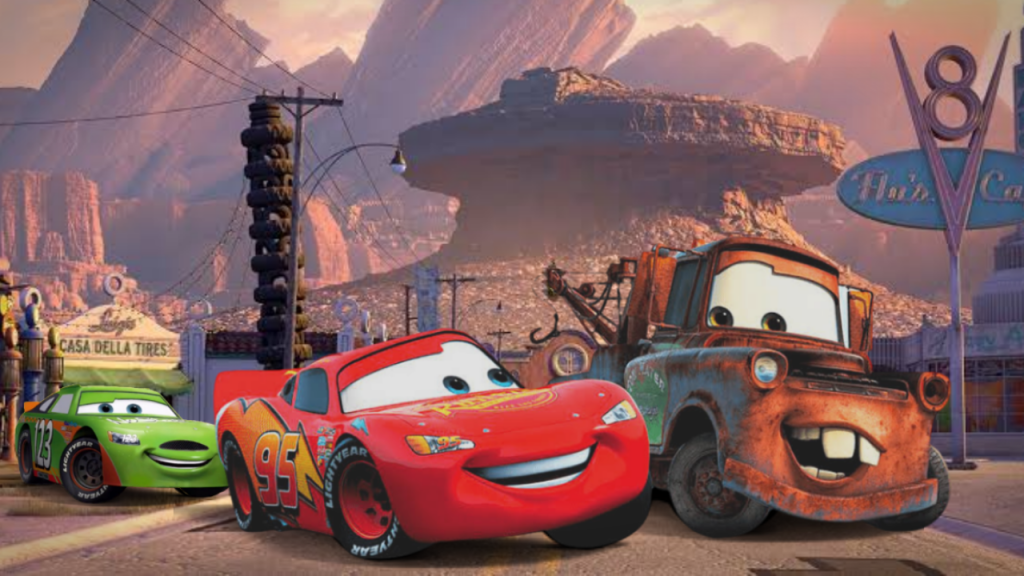
Having a stable community and home matters. And while Radiator Springs was able to be revived by Lightning McQueen’s mere presence, the model of using celebrities or being blessed by the proximity of major highways aren’t sustainable answers for the vast majority of our towns and cities.

That’s why the verse from Jeremiah is so moving. He’s directing a people who have just been taken into exile to care for the city they now live in. They aren’t in Jerusalem anymore. They have been scattered from their homeland by the Babylonians. And yet, Jeremiah encourages them to seek the prosperity of the city to which God has carried them.

So what does that mean for us? To seek the prosperity of the communities we live within will require making some sacrifices of time, money and effort to get connected. Possibly choosing to stay at a job longer and resisting the urge to optimize our personal resume and pay to allow deep roots to form. Choosing to be around other people who may be difficult to connect with instead of taking the “easier” route of isolating. And maybe deciding to take the longer trip on the backroads to pay a visit to those overlooked communities, both literally and figuratively.

For by doing this I think we can all follow a similar character arc to that of Lightning McQueen. A broadening of our perspective to see beyond our own personal endeavors and the potential blessing that can be brought to those around us. Hopefully similar revivals to the places we call home, much like we saw with Radiator Springs.

For they don’t revive by themselves. They are saved by those who stay, even when it’s difficult, and care for them.
The Devolution of the Super Hero and the Decay of Social Capital

While everyday that passes can certainly be considered just another day in the books, there are particular events that you know, even as they are still unfolding, will remain the topic of conversation for years to come. The types of events that will likely make there way into textbooks. That our kids and grandkids will ask us about. That will be considered pivotal moments for our culture. The cliché phrase “we’re living through history” seems all too fitting for these trying times.

Is it an overstatement to say the rioting at Capitol Hill fits that category? Or even that much of the social strife experienced over the past year will be worthy of reflection for future generations? Events filled with opportunities to teach lessons or at least offer a snapshot of what life was like within the United States in the early 21st century?

While it’s always difficult to assess the significance of a particular event within such a short timeframe, this feels even more difficult to put into words. Was this the climax of a long-building crescendo? Or is this just another “bump” in the long road of turmoil within our nation?

How did we get here? Whose fault is this? Where do we go from here? And how could this have been avoided?

As to be expected, there are many who are quick to give answers or at least vent their frustrations. Who’s at fault? The President? His base? The party that never reeled him in? Fascists? White supremacists? The patriarchy? Fake News? The Swamp? The Deep State? It depends who you ask. But for so many in this country, still living through the fog of a tumultuous year, the answer is crystal clear. The problem is the other tribe and it has been for a long time.

What’s sad is that in almost every rant that makes its way onto social media, there are at the very least kernels of truth. There’s no shortage of reasons to cast blame on pretty much everyone mentioned previously, which is what makes this so messy. One can easily make the case, that just about everyone has contributed in some way to getting us to this point.

And so, as much as we may want to cast judgements on the events of the recent past, it may be helpful to remind ourselves that this isn’t an isolated incident that came out of nowhere. It may be even more helpful to view this event against the backdrop of larger undercurrents that have been forming within society over many years and decades. To take a step back and try looking at it from a 10,000-foot view.

As I so often do in many of these posts, I find movies and TV shows so incredibly helpful because they represent the stories we tell ourselves that both inform our culture and reflect where it currently stands. Often popular art can give us a glimpse into where we’ve been, where we are, and where we’re going. And I can think of no genre of movies and TV shows that reflects this evolution (or maybe better put “devolution”) more clearly than the super hero genre.

these aren’t your granddaddy’s super heroes

I’ll admit. I’m no comic book junkie. The extent of my comic book reading as a kid consisted of Calvin & Hobbes, Dilbert, and The Far Side. I never really dabbled in the super hero genre. It just wasn’t my thing.

My exposure to super heroes as an adolescent was largely relegated to an occasional viewing of the Batman animated series and the live action Batman and Robin movies. You know, the ones with the over-the-top “KAPOW” and “BANG” lettering intermixed with each and every fight scene. It was enough for me to ask for my own Batman utility belt. But that was about the peak of my interest.

But my love for the super hero genre, really began with the first Iron Man movie and the introduction of the Marvel Cinematic Universe (MCU). I know I’m not alone in feeling this. Marvel Studios has been producing many of the highest grossing movies of the past decade, (for good reason) and continues to pump them out at an increasing frequency, no doubt to capitalize on an opportune moment while popularity remains high.

Sure the visual effects and CGI has taken current films to a completely new level of production quality than the older films. But maybe one of the most notable changes has come with the with the characters themselves.

Unlike the typical superhero trope of the past, none of the super heroes within the MCU maintain their secret identity. Ever since Tony Stark revealed his identity as Iron Man in the first movie, almost none of the characters have maintained an alter ego. There is no stark division drawn between their public and private lives. And that means for the viewer, you are presented with all of the flaws and weaknesses of the heroes.

In the past, clear lines were drawn between good and evil without much of a character arc required within the individual. But in today’s movies, although there are certainly clear “good guys” and “bad guys”, the protagonists have flaws, and deeper context is given for why the antagonists became who they are. Changes that certainly make the movies all the more engaging and are worthy of note.

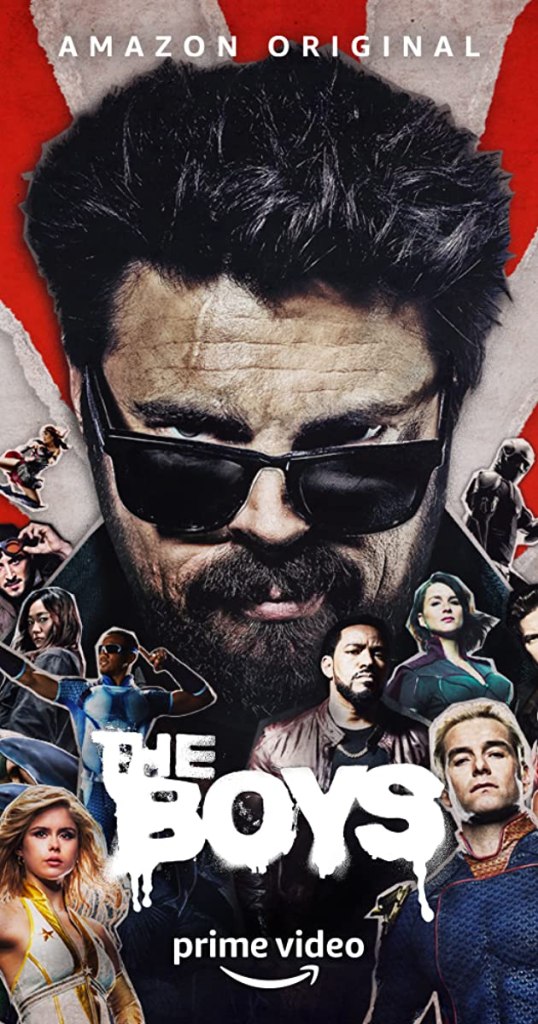
But where this genre really takes a turn is with one of it’s most recent adaptations. The Boys, a very popular TV show on Amazon Prime that just finished its second season, demonstrates this shift in culture by very clearly contrasting itself against the many super hero stories of the past. And boy oh boy (pun intended), is it a doozy.

The show was recommended by friends of ours. With an 8.7 rating on IMDB, many award nominations, and considered one of the most popular shows today, this show is certainly drawing a lot of attention. And as usual in our household, Morgan started watching without me. Go figure. But I just so happened to sit down in time to catch this scene from the fourth episode which gave me an introduction into what this show was all about and I was immediately intrigued by its message.

Disclaimer: There is swearing, blood/gore, and disturbing content in this clip. The show is rated for mature audiences. While there is no sexual content in this clip, please know for future reference the show itself does contain pretty gratuitous amounts of it in the remainder of the show. In short, I don’t recommend this for kids.

I’m not sure if this scene hits you as hard as it hits me, but I can’t help but feel my stomach turn when they lie to the passengers that everything would be okay and abandon them to their demise. This scene encapsulates in just a few minutes what this whole show is about.

Clearly Homelander is a parody of Superman. Queen Maeve, a parody of Wonder Woman. There are other super heroes that allude to Aquaman and to The Flash. This whole show takes the oh so familiar concept of a group of super heroes like the Justice League, and flips it on its head. What if those who are responsible for our protection aren’t just incompetent at times, but they’re actually malevolent?

If you watch the show, you will see that this twist doesn’t just occur with the super heroes. Nearly every institution in this show is untrustworthy. A Christian organization is led by a man that is sexually deviant in private after condemning it publicly. A big pharmaceutical company is led by completely dishonest leaders and misleads the public every step of the way. Politicians are corrupt. Cults take advantage of their followers for monetary gain. Many of the relationships depicted are absolute train wrecks. Innocent bystanders killed all the time in both domestic and foreign affairs. And the show makes barely veiled allusions to many of our cultures hot-button topics like white supremacy, the #MeToo Movement, and police brutality. It has it all!

This show is at its core a thought experiment. What if we took the super hero concept and made a dystopian version of it? That my friends in a nutshell is The Boys. A show that probably would not have received anywhere near this level of popularity in the past. A show that probably won’t stand the test of time. But a show that shows so saliently what so many are feeling today.

And what’s their proposed solution? “The Boys.” A group of nobodies who have been hurt in the past by these super heroes and who group together to take down them down through not only non-violent means, but also through violence. The solution is a grassroots resistance rebelling against the powers at hand. Does this sound familiar?

The Decay of social capital

It may not come as a surprise that public trust in government has been hovering around an all-time low for much of the recent past. The below chart from Pew Research shows just how precipitously we’ve declined in trust in public officials these past 60 years.

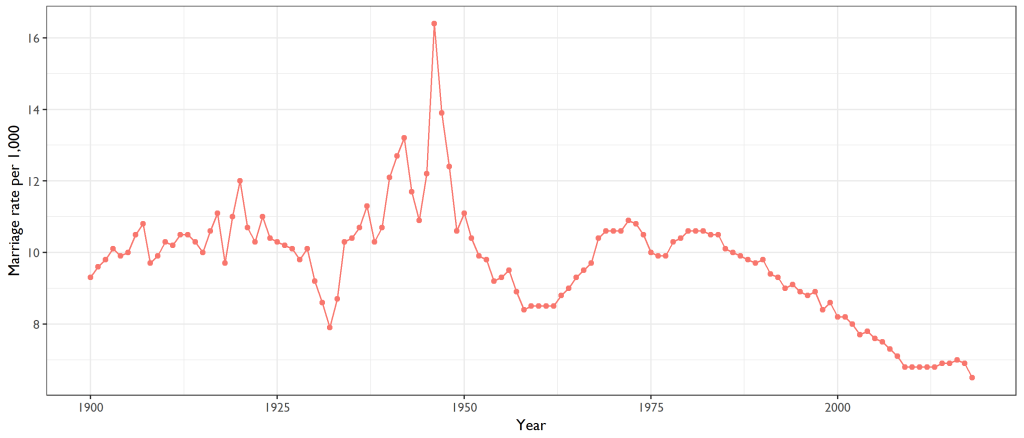
Then one could look at the status of marriages over the past century and the waning influence it has within our society. And with the reduced rate of marriages, we have seen related patterns in the increase of babies born out of wedlock, certainly a condition that does not afford stability to the children – a storyline I would note that one can also find within the plot of The Boys.

I’m sure one could easily find similar studies showing trends for diminished trust in the police, our neighbors, clergy, state and local officials, schools, etc. And similar levels of disconnection from other institutions like church, community groups, friends and family. Despite having the ability to connect more easily today with anyone around the globe, we are more disjointed and less trusting of those around us.

Is it any wonder why a show like The Boys would resonate with people today yet almost certainly be incredibly off-putting to generations past? Is it any wonder why so many on both the right and left are resisting and rebelling against who they perceive to be the perpetrators of these conditions? Is it any wonder that many feel that resorting to violence is the only way for them to feel heard?

Social capital is rarely mentioned measure of a culture’s health. Honestly I wasn’t familiar with the term until very recently, but it is quite obvious once you hear it. Social capital is the value of the relationships within a society that not only bind us together, but propel us to live admirably and function effectively. High trust within a society reduces the need for regulation. Moral behaviors that arise from constructive relationships reduce the need for law enforcement. Social capital provides increased levels of satisfaction, stability and predictability to our lives. And it affords opportunities for the most disenfranchised to be heard when those relationships are prioritized between all levels of the hierarchy.

When societies are functioning at their best, social capital is high. Sadly many of the previous attributes mentioned do not describe the experiences for many in our nation today. In many regards, that dystopian vision of The Boys is not too far off from what many perceive to be reality. So what can we do?

so how do we build social capital again?

One may say that maybe our trust in the government in the past was too high. That the very carefully crafted propaganda of our past that afforded such a unifying vision of our country’s leadership cannot occur in this modern era, nor would we want that. Can you imagine a current president being able to hide for years their limited mobility like FDR did in the past?

Like that aforementioned change made in the MCU movies, for better or for worse, we are presented with far more of the strengths and flaws of our leaders than at any time in the past. With cameras everywhere and an expectation that communication not just come from polished speeches but from half-baked tweets, we will get an up-close view of not just their public lives, but their private lives too. In fact, with the advent of social media, we’re confronted with the best and worst of many of our peers as well. To some degree we need to learn to live with the messiness of one another that is aired out for all to see in ways it hasn’t in the past, including our leaders (not to be mistaken as an excuse for these recent riots).

But there are many other changes that have been occurring within our society over the past several decades. Many seemingly small and innocuous decisions are made by all of us that over time accumulate. The decision to continue a marriage or end it. To get to know our neighbors better or ignore them. To attend church and invest time into the community or spend every leisure hour on ourselves. To be diligent at our work or let our quality slip when no one’s looking. To be dependable to our children, parents, and friends or look out for #1. To build social capital, or to let it decay.

We didn’t get here overnight. And we’re not getting out of it as quickly either. We don’t have to live within a dystopia. But in order to promote trust in our institutions again, the people who make up those institutions have to start generating more social capital again. And violence is never constructive.

Jesus said to his disciples in the hours leading up to his execution, “Put your sword back in its place, for all who draw the sword will die by the sword.” (Matthew 26:52)

Jesus found himself within the midst of a very harsh culture war and instead of resorting to violence he encouraged his disciples to seek a new way. The Boys glorifies violence as its solution to the problem of malevolent actors. Jesus proposed a different, albeit far more costly and difficult way to approach others, even our enemies.

To continue to invest in others, even when it’s at the cost of yourself. Those aren’t the type of heroes we glorify today. But those are the heroes we need to turn things around. Then, and only then, will we actually begin to see and feel indications of healing. And maybe, just maybe, we will look back at these recent events as the pivot point towards something better.

It’s up to us.