Wrestling with the Age of the Earth Question

The other day Tristan, my oldest (6-year-old) son, asked an excellent question.

“Dad, is Earth 2,025 years old?”

Kids have an innate gift for asking such seemingly simple yet profoundly difficult questions. Ones we adults don’t even think to ask and are often challenged to answer.

His intuition is natural. Why wouldn’t it be 2,025 years old? All of our calendars say as much.

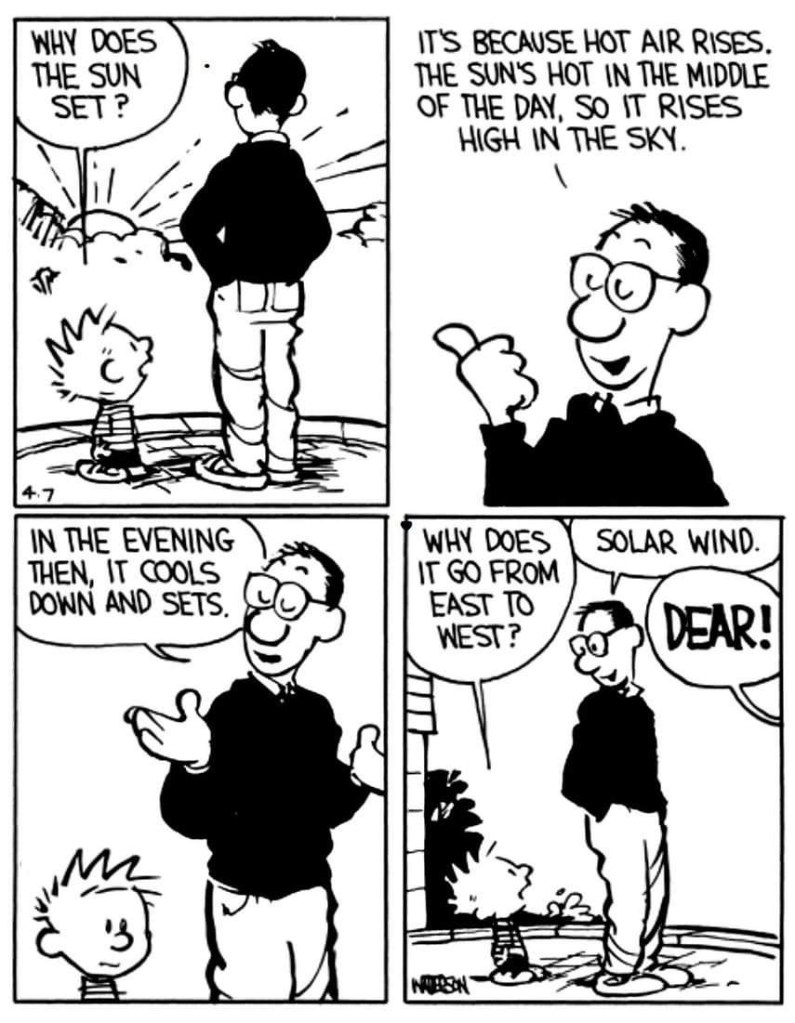
Put on the spot, I don’t think I did a great job articulating my response. I obviously answered no, but the very apparent follow up questions were difficult to address. If you asked Tristan, he would likely say he had no idea what I was trying to say. It probably resembled something similar to this conversation between Calvin and his father…

Many Christians, like myself, will continue to wrestle through this dichotomy that has been handed to us. First, that the scientific consensus largely holds the belief in a very old Earth – billions of years old. And second, that if one were to take a very strict literal interpretation of the Bible, that Adam and Eve (and therefore we assume Earth) were created roughly 6,000 years ago.

This topic ignited theological, political, and cultural arguments in the early 20th century, due to the growing adoption of this new evolutionary theory, and the associated old Earth cosmology. It might seem trivial but, at its core, that fight was over whether the world was crafted with intentionality or simply the result of natural selection and randomness. Was the creative process top down or bottom up? Was there meaning and purpose to existence or not?

Those discussions have slowly faded over the past several generations. I suspect many in the church have gone quiet on this issue to avoid the discomfort, opting to ignore the topic instead of fiercely debating it.

And while ignoring this uncomfortable topic is certainly a strategy, I don’t think it’s the best one. I don’t know if my kids will let me plead ignorance. And for my own sake, I want to give this some thought.

If the assumption is that God created everything from nothing within literal days prior to his creation of Adam and Eve, these conflicting understandings of the age of our planet would seem to be irreconcilable. Hence the fierce debate.

And this has often led to two oppositional approaches for those who choose not to simply avoid altogether. You can dismiss or selectively choose scientific findings to uphold this particular form of literal reading of Genesis. Or you can diminish or discard the Bible, or at the very least the Old Testament, for the sake of adopting the currently prevailing scientific view.

But is it possible that there is a third way of approaching this question?

Both kids and adults alike are fascinated and unsettled by this question. I’m no exception. I want to try to understand it well enough to translate to my son another potential viewpoint. One that allows us to engage with both worldviews because I don’t think they need to be considered mutually exclusive. Is it possible to hold the Bible in highest regard while also giving credence to what we believe to be valid scientific findings?

Some may accuse me of mental gymnastics on this. So be it. But I wanted to share honestly how I have tried to grapple with this question. Not that I have all the answers or that my opinions won’t change with time.

But I’m viewing this post as an attempt at describing this third way, an approach that can be described as a functional or theological reading of Genesis 1 rather than a material one. That this passage isn’t concerned with God creating matter. It’s narrating how he creates an ordered world from disorder.

Is Earth 2,025 years old?

The immediate answer to Tristan’s question is undoubtedly the easiest to answer. No, it isn’t 2,025 years old. But it’s the very obvious follow-up questions that make this challenging.

If Earth isn’t 2,025 years old, then how old is it? And why do we state the year as 2025? Why not 1? Why not 4,540,000?

Again the easiest answer to give is to say for many centuries the year 1 from which all our calendars are measured, has traditionally corresponded with Jesus’ birth. I think many people are aware of that. Whether you have faith in Jesus or not, we have been handed this method of telling time by our ancestors who did.

For me, that raised some questions of my own. When did we decide to retroactively ascribe this date though? The way we number years today can feel so natural that it’s easy to assume it has always been that way.

A little researching made me aware that the AD system was introduced in 525 AD by a Christian monk named Dionysius Exiguus. His goal was not to create a universal calendar, but simply to calculate the date of Jesus’ crucifixion. To do so, he proposed counting years forward from what he believed to be the year of Jesus’ birth, labeling it Anno Domini—“in the year of our Lord.”

This system was not immediately adopted though. For centuries, people continued to date years based on local rulers, reigns of emperors, or significant political events. It wasn’t until the 8th and 9th centuries that AD dating became common in Europe. Even then, it took many more centuries to become the global standard we use today.

Modern historians also believe Dionysius was likely off by several years in estimating Jesus’ birth, meaning our calendar is also slightly misaligned with the event it references.

In other words, the year “2025” is not a measurement of Earth’s age, nor even a precise measurement of how long it has been since Jesus was born. It is a culturally inherited reference point, chosen for religious reasons, that was slowly standardized over time.

We have always measured time, but not all cultures have measured it the same way or for the same reasons.

In the ancient world, years were often counted according to the reign of a ruler. “In the third year of King so-and-so…” “Ten years after the great flood…” “Five years after the founding of the city…”

The Jewish calendar dates years from what is traditionally understood as the creation of the world, placing the current year at roughly 5,700+ years, which is very close to the 6,000 years many modern Christians state. This number is derived from genealogies and narratives in Scripture. Interestingly, it also falls within the broad era generally associated with the rise of the earliest cities in ancient Mesopotamia.

The Islamic calendar begins in 622 AD, marking the Hijra, Muhammad’s migration from Mecca to Medina..

The traditional Chinese calendar cycles through repeating eras tied to lunar and solar patterns, emphasizing harmony, cycles, and renewal rather than a single linear starting point.

Modern science uses yet another framework entirely. Methods like radiometric dating, astronomy, and geology allow scientists to estimate the age of Earth at approximately 4.54 billion years. This number is not tied to human events at all, but to physical processes measurable in rocks, stars, and atomic decay.

Even the French Revolutionaries in the late 18th century wanted to start over from year 1 on their calendar and break from the AD system. They wanted their movement to no longer be associated with the Christian story. They wanted to write their own.

Throughout human history the reference point used for timekeeping means more than just a number. Calendars do not tell us how old the world is. They tell us what a culture considers important enough to measure time from. They tell us what story we are living within.

Timekeeping has throughout human history been functional and relational, not absolute.

Earth was Established When?

Very often you will drive by a restaurant or company that notes the date of their establishment. Sometimes it’s to indicate the amount of experience they have. For others it seems to be to indicate their newness. For others it seems just to be a sense of pride, a reminder of when or where they started.

But what do they mean by establishment?

Is it the date the building was built? Not necessarily. Some companies retrofit existing buildings and some don’t use buildings at all. Some even move to new locations or demolish and rebuild new buildings while maintaining the same establishment date.

Is it the date of birth of its founder? Is it the date a chef came up with their first recipe, the owner got their degree, or the furniture within was built? The answer to all of these are obviously “no.”

It is very clear that this establishment date marks the initiation or creation of something, not in a material sense, but in a functional sense.

The combination of employees, services, values, culture, history, and yes to some degree, the material components like buildings, furniture, and material assets, aligning together to serve a particular function.

It is this date, when doors are open to treat patrons to a new culinary experience, product or service, that marks its beginning. Where the sum has become greater than its parts. When the creative process has hit the pivotal moment where it can be shared with others.

So what is the Earth’s establishment date?

What does “Create” mean in Genesis?

The term “create” used in Genesis 1 is בָּרָא (baraʾ). The intended meaning of this word is better understood not as creating something from nothing as many posit, but as creating something functional from the disparate raw materials. This creative role is more like a CEO establishing a company or a sculptor creating a moving piece of artwork from a block of marble.

Unfortunately, by trying to find congruence between the modern materialist view of the universe’s beginnings, many Christians have flattened the text, treating it like it’s a scientific order of processes instead an ancient work of literature that is borrowing and differentiating from the polytheistic worldviews of their neighbors at the time.

Very quickly in the text one would see that God has made light before he makes the stars in the sky, which doesn’t map cleanly onto our modern understandings of how this works scientifically. If Genesis 1 were an instruction manual for making the world, it appears some steps are out of order.

But that’s not the purpose of this text. As John Walton, a biblical scholar and author of The Lost World of Genesis One observes, the seven days of creation are better understood as follows:

Days 1-3 God creates functions by dividing or separating. Day 1 establishes time by separating light from dark. Day 2 establishes weather via the separation of waters above and below. And Day 3 establishes agriculture with the separation of land from the sea.

Days 4-6 God creates functionaries by filling these spaces. Day 4 provides the stars and moon. Day 5 provides the birds of the sky and fish of the sea. Day 6 provides the animals, including man, on the land.

And Day 7, God rests. He abides in his newly made temple (Earth), essentially taking his place in the control room of his newly established corporation. Earth now serves its intended function. Order was established from chaos.

In this ancient cosmology, the world manifest itself in the cycles and patterns of life: sunrises and sunsets, seasons, and the ritualistic patterns of animal migrations and habits. And, contrary to the beliefs of their neighboring cultures, God was not the sun, moon, animals, skies or seas but transcends all of them.

The text beautifully and succinctly describes how a world with very clear structure and function was designed intentionally and not just the result of randomness, much in the same way a corporation or restaurant does not just accidentally emerge from nothing.

So How Would I Answer Now?

If given a second chance at this question, here’s how I would try to answer:

No, Tristan the world isn’t 2,025 years old. It has existed for billions of years. But God slowly formed it into the type of place where people could start building, farming, caring for animals, and being creative themselves in a similar way to how God is creative. God was taking his time to make a world where both he and us could reside.

The 2,025 years reminds us of when Jesus was born. And with each passing year when that number changes we’ll be reminded again of Jesus.

I will continue to wrestle through this and suspect I will never have a completely confident answer in this lifetime. And that’s okay. If anything I hope it leads me to more awe and humility.

I think there’s a reason this topic has historically been absent from the church’s creeds. It’s important but not the most central aspect of the Christian faith. And I think there’s room within the Church for some varying interpretations.

But I’m glad that I have a son who will challenge me to think deeply about this and maybe find more appreciation for the seemingly mundane parts of life I’ve taken for granted. Something even as simple as the year on the calendar.

For it reminds us of what our culture has historically recognized as most foundational. The life, death and resurrection of Jesus Christ. It’s a story we can live in too and be reminded of with each passing year.

That is, of course, if we see it as more than just a number.

Why We Shouldn’t Throw Away Fairy Tales

One of the things I most look forward to as a father will be the opportunity to read stories to my son. Morgan and I have already started the habit of rocking him to sleep while reading books and I am excited for when he’s old enough to really engage with the stories.

For some reason, there’s something about stories that resonates so much with me and maybe that’s the case for you as well. I’m not ashamed to say I’m the type of guy who gets teary-eyed at the end of movies like Up, Wreck-It Ralph, and Toy Story 3. How can you not shed a tear when Carl gives Russell the Ellie badge, when Ralph is sacrificing himself into Diet Coke Mountain, or when Woody, Buzz, Jessie and their friends are all about to be melted in the incinerator and they are locked arm-in-arm facing it together?

These stories don’t have to be animated films though to create these deep feelings. Maybe war films like Saving Private Ryan conjure up similar emotions as you witness their camaraderie and sacrifice. While they aren’t usually my cup of tea, romantic films like The Notebook get people welling with emotion as they see the deep love Allie and Noah share. Or maybe you were feeling emotional when half of our favorite heros from the Marvel Cinematic Universe vanished into dust before our eyes in Avengers: Infinity War. Hopefully no one needed a spoiler alert on that last one!

Maybe the stories that most resonate with you are from literature. I remember the shock when reading Harry Potter and the scenes when Dumbledore and Snape died. As with any great piece of fictional writing, these were characters I had come to know and identify with and to read of their deaths was to in some way experience that myself.

These experiences drive us go to the movies and read books. These stories seem to point to certain values or ideals that resonate with so many of us. Even when we can’t articulate into words what exactly in the story resonates with us, their impact is felt. In a way, these fictional stories, although they are not necessarily true historically, abstract out themes and concepts that are incredibly true to our real-life experiences as human beings.

What’s interesting is that lately there seems to have been more dialogue about Disney’s princess stories. Now I’m not going to argue that the Disney version of these older stories are the epitome of fairy tales, but I do think that they are the ones we collectively are the most familiar with.

Keira Knightley, an actress probably most commonly known for her role in the Pirates of the Caribbean, recently said on Ellen that the movies Cinderella and The Little Mermaid are banned in her house because of their depiction of women. Her comments sparked some discussion with people voicing both support and opposition to her thoughts. I don’t think she’s alone in holding these opinions.

Even a scene in Ralph Breaks the Internet, featuring the Disney princesses, which I will admit I found to be humorous (and still do), poked fun at the past princess stories that Disney had created and as stated in news headlines “spoofed the Disney Princess Industrial Complex” and was a “moment that mattered.” A scene like this would not have happened if Disney did not realize this was a widely shared sentiment.

As funny and creative as that scene is, the question remains… Is what this scene portrays about these older stories true? These movies have been mostly acclaimed since they were released. The question is then what changed recently? Are we better people today that we can look back on these stories and see them for what they really are? Or do we have a different and maybe inaccurate perspective on what these stories were really meant to convey?

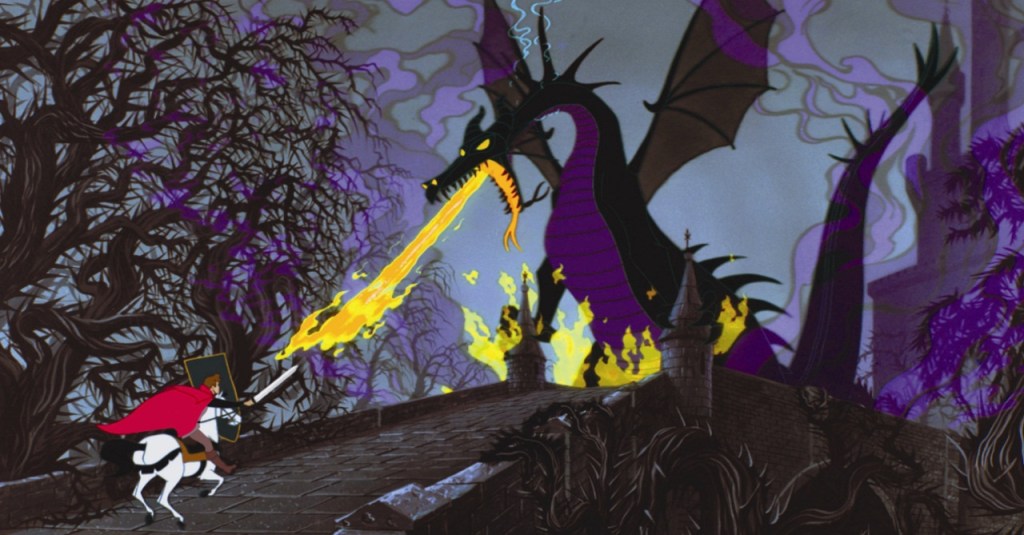
Take Sleeping Beauty for instance. This is a story that could very easily be construed as “a woman is in trouble and needs a big strong man to save her.” There is the obvious plot line of being willing to fight for true love, which I don’t think is necessarily a bad thing to teach. However, I think Sleeping Beauty contains a strong lesson on parenting.

Aurora’s (Sleeping Beauty) parents, did not invite Maleficent to Sleeping Beauty’s christening. In essence, her parents were unwilling to allow anything that could be potentially dangerous into her life, which I think we all know, whether or not we want to admit it, is impossible to do.

They were then confronted by Maleficent and issued a curse that on her 16th birthday she would die from pricking her finger on the spindle of a spinning wheel. Her parents then decided that in order to protect their daughter, they would burn every spinning wheel in the kingdom and send her away to live with the three fairies. They decided to keep her secluded from all spinning wheels, which I think is a metaphor for all potential things that they believed could cause her harm. Interestingly though, they couldn’t keep her from pricking her finger on the spinning wheel as Maleficent still found her way to Aurora.

There is so much more to this story that could be extracted. We could learn from the isolation of Maleficent contrasted with the family and community of all the other characters. Or we could compare Prince Phillip’s courage to the fear of Aurora’s father. Or how about the importance of strong female supporting characters (which is present in a lot of these fairy tales) around Aurora and the importance that mentorship has in a young person’s life.

In Beauty and the Beast, Belle is responsible for redeeming the Beast and is by far the most admirable of all the characters. Gaston, represents the epitome of the self-aggrandizing jerk that I hope we all agree no man should be emulating. Ariel, Pocahontas, and Mulan all represent incredibly strong and courageous women in their stories. Cinderella is a great demonstration of good things coming to those who are diligent with their responsibilities and that is a great lesson for men and women of all ages.

Disney adapted these fairy tales that had been passed down for several centuries across cultures. There are reasons these stories were shared for so long and that Disney was willing to adapt them into films. You can compare it to evolution and survival of the fittest. These stories that have been handed down to us have been maintained because they speak to some of the deepest virtues and values that we have come to embrace as a culture better than other stories that have been told. Yes, they may be imperfect stories, and worthy of critique, but I think we need to be careful about thinking we are so different or (even worse) better, than our ancestors and that they cannot through their stories speak into our lives.

For the same reason that not every movie and story made today will be remembered 100 years from now, not all stories of old have been passed down by our ancestors to us. There’s a reason Lion King will be remembered and not The Emoji Movie or why books like The Lord of the Rings and Harry Potter will last instead of The Twilight series.
I’m not saying we can’t joke about these movies. I just think we need to carefully watch what we joke about, because it very easily and quickly be adopted as “truth.”

It feels like there has been a growing disdain or casual indifference to most of what we inherit. It’s almost like we’ve become so preoccupied with the mistakes of our ancestors that we are now in the process of trying to clean the slate of their influences in our lives, which often manifests as the throwing away of everything that they created, valued, and passed down to us, including their stories. We view these older stories as antiquated, irrelevant, or (even worse) oppressive in the themes they portray.

However, I think there is a real danger in this interpretation of these stories and as a result the dismissing of them. Reducing each of these stories down to the plot line of “a woman is in trouble and needs a big strong man to save her” or fill in the blanks “_ is oppressed and needs the oppressor __ to save them” is stripping these stories of their real value and intended message.

I’m not saying there’s never been oppression, nor am I saying that these stories are perfect in the stories that they tell. However, I think we will be giving up on some of the best stories we have to learn from and discrediting the significance of what our ancestors learned if we just throw them away. I believe that the degree to which we decide to give critical thought to the themes of these stories is the degree to which we will draw benefit from them. Yes, we can still criticize these stories, but to discard them could be like throwing out the baby with the bathwater. And if that’s the precedence we set, why should we expect our descendants to want to hear any of the stories we tell?

C.S. Lewis once said, “But some day you will be old enough to start reading fairy tales again.

I hope we can continue to give these stories a chance to teach us and consider why they have been deemed valuable for so long. I think they have so much to teach not just my son, but me as well because they have been shared with so many people across time and have resonated with so many. I don’t want to be a parent, like Aurora’s father, that in an effort to shield my son from all of the potential malevolence in the world keeps him from living his life. Similarly , I think it’s much better to engage with these stories and be able to learn through the process, then to not even give them a chance.

Let’s be careful about what we decide to throw out  because our ancestors are worth listening to and we may be getting rid of the very best they were trying to share with us.