Literally False, Metaphorically True

Two brothers who have made their rounds on podcasts these past several years are Bret and Eric Weinstein, members of the self-named “Intellectual Dark Web.”

The “IDW” (for short) consisted of several counter cultural thinkers (many from academia) who were resisting anti-liberal movements underway on college campuses and within the zeitgeist of western societies more broadly. Their commonly shared beliefs over the preservation of Enlightenment values (with an emphasis on free speech) allowed them to have frank conversations about their conflicting views on a whole host of, what to them seemed to be, secondary issues. Conversations that were often drawing large crowds and filling arenas and theaters and millions of views online.

One of the fascinating developments within this group however is the struggle with how religion is to be handled. Some like Jordan Peterson tried to emphasize its integral role in Western thought. Others like Sam Harris denigrated it as nothing more than a social contagion worth exorcising completely. And then there were a wide range of views in between.

For Eric Weinstein, an avowed atheist as he indicates in his tweet, the notion that these truths we believe to be self-evident – our equality before God as individuals and certain unalienable rights – apparently do not appear to be as evident to the citizenry today as it was to our Founding Fathers and their contemporaries.

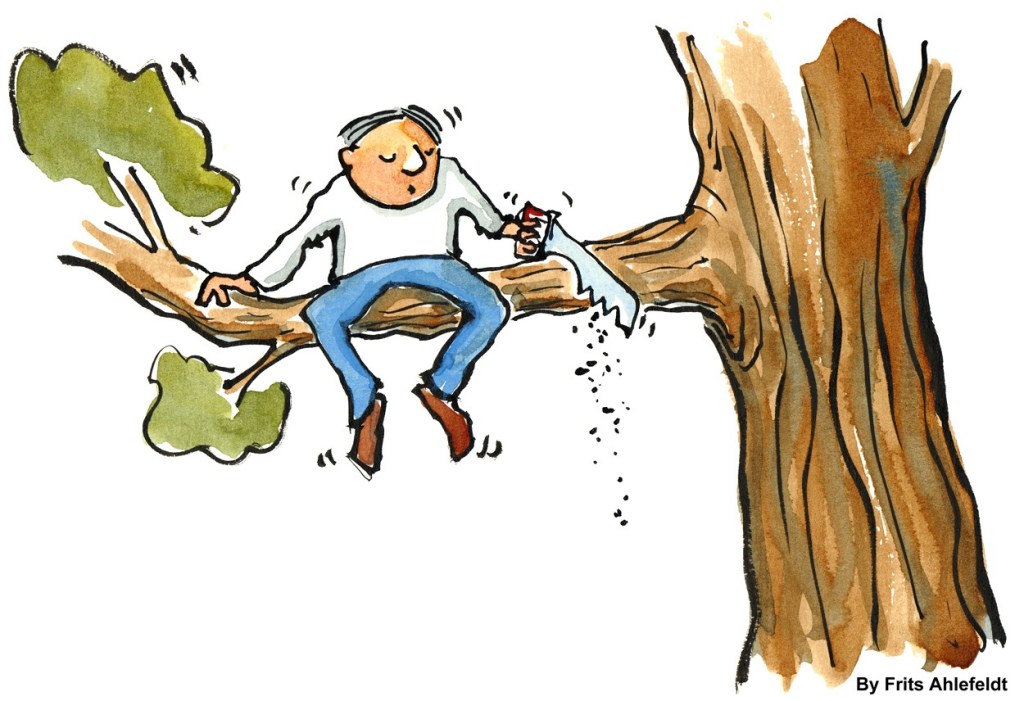
Some of these staunch atheists realize that – much like a man sawing off the branch he is sitting on – society appears to be secularizing to the point that maybe we’re detaching from the very root of what gives us our values. As Eric says, these words are “load bearing.”
Cue Eric’s brother Bret, a former evolutionary biology professor, who had this engaging conversation with Jonathan Pageau, an Orthodox Christian and artist.

The contrast of their worldviews becomes very apparent in the final 30 minutes of the conversation. Bret frames religion in the following way: “Literally false, metaphorically true.” The crux of his point is that a religion like Christianity is not accurate in its truth claims about origins, history, science, etc. however, it’s a useful fiction for affording us the values and reigning in the bad behaviors of individuals so as to allow civilization to foster.

He goes on to use the analogy of a tennis player who is told to swing through the ball. In Bret’s opinion, what the racket does following its contact with the ball has no bearing on the ball’s flight path. And yet, coaches often use this as a teaching tool to get a proper swing. “Literally false, but metaphorically true.”

A similar story he uses in other conversations is of a native island tribe who believes in a tsunami god. They pass down stories through the generations of how the tide receding into the ocean is the tsunami god preparing to attack their island. This story affords people who never experienced a tsunami within their lifetime to have the ability to respond appropriately (finding high ground) when the situation eventually arises. In essence, from an evolutionary perspective, the religion, while not conveying a “literally” true explanation of what is occurring, provides benefits for the continuation of entire people groups.

But Bret goes further with his tennis analogy and concludes that if the tennis player starts losing the game, their coaches must find some new teaching tool with which to correct the player’s technique. A teaching method different than the “swing through the ball” advice given by coaches of the past. This is consistent with the more alarmist position he takes regarding the state of western culture more broadly. It also seems to fit his worldview that places an emphasis on change and evolution. In his opinion, the religions of old are inadequate to respond to the challenges of today and therefore a new answer to today’s problems must be found.

Jonathan however takes his analogy and flips it on its head. Is the tennis player possibly losing the game because his coaches started telling him it doesn’t matter if he follows through? Is his abandonment of what worked before what caused him to fall behind in the first place? Is he more likely to succeed if he continues to follow the advice of past generations that has gotten them through trials before?

Maybe the best recent nonreligious example of Bret’s “literally false metaphorically true” theory is public health during COVID. Framed as charitably as possible, we could say that for the sake of encouraging people to make the “right” decisions for collective health of society, some of the literal truthfulness of the public health officials’ claims was abandoned. Inconvenient truths that would have been counter productive for their urgent goals were omitted. To achieve expediency, they were willing to sacrifice honesty about the scientific conclusions (or lack thereof) at the time.

The origin of the virus. The efficacy of the vaccines. Two weeks to stop the spread. Risks to different age groups and demographics. That’s just a few that immediately come to mind. Each of those errors eroded trust. Whether it was malevolence or purely ignorance, it wreaked havoc on the credibility of the public health profession.

So what lessons can be learned from this?

As a parent and as a youth group leader at our church, Bret’s words prompt me to think through what it is I want to pass along to those who come after me. I’m confident that at the very least what Christ’s life and death has afforded to those within the Church is metaphorically true. That if you live as if it’s true (like swinging through with a tennis racket) and not just living for the here and now (YOLO) but for things of eternal value, you wind up producing the best results in the here and now as well.

Maybe nothing can serve as a better example of that is Jesus. He was willing to lay down his own life in pursuit of something of far greater value. We can debate whether or not he accomplished through his crucifixion the eternal salvation of those who trust in him in the life to come. But we cannot deny the incredible power of that act, which has rippled through history and impacted society considerably even if it is only metaphorically true. Even avowed atheists like the Weinstein brothers concede as much.

But then we need to take another step and question the “literally false” part that has the potential to undermine long-term trust, much like public health did in the past few years. As a parent I would not like to hand down to my kids and to the young children something that omits inconvenient truths or outright includes lies just to get a result in the immediate. I want to hand them the best map for navigating life I can, which admittedly will never be perfect.

But maybe that’s where being honest about areas of doubt or exposing kids to the diversity of views on topics that even the church has had debates over throughout history would keep the next generation from questioning the trustworthiness of adults in the long run.

For deconstruction of faith so often happens on the basis or interpretations of topics like Genesis, debates over the church’s stance on social issues, and literary criticism of the Old Testament, all which fall outside the purview of the creeds of the church historically. Maybe it’s worth reflecting on what is and is not included within those commonly shared belief statements. For should one’s entire faith hinge on an interpretation of difficult to read books like Genesis or Revelation? Not that these aren’t profound books of the Bible, but distilling their messages into simple prescriptions or belief statements is impossible.

That being said, I struggle with Bret’s proposition about finding a new answer to today’s challenges. I haven’t seen to date a better alternative to the Christian worldview or something that I could fabricate that better explains who we are, our purpose in life, and how best to live it out. I’m more in the camp of Jonathan asking Bret why we have to abandon what has worked before. Have prior generations not faced difficulty and hardship? It seems intrinsic to the human experience.

I’ll put my trust in the man that was willing to die for others and the power that comes from his name. The downstream effects through western society from his life, death and professed resurrection are apparent. And as we all watch as we saw off the branch we sit on, I’ll continue to suggest that we take a break from cutting and give greater credence to the trunk and roots that hold us up. This worldview and the values it affords aren’t as self-evident as it used to be. And maybe this gives us an opportunity to appreciate it all the more.

Self-Control and How to Teach It

“You had one job to do!”

That’s the quote that comes to mind whenever I read this particular verse in Paul’s letter to Titus. It’s a simple verse, but one that causes me to chuckle a bit every time I read it.

“Likewise, urge the younger men to be self-controlled.”

Titus 2:6

HA, Ha, ha…? Wait, what exactly is it that makes this humorous? In fact, it doesn’t seem funny at all.

Well, the humor isn’t exactly evident within the verse itself. But it emerges once the preceding verses are considered.

“But as for you, teach what is consistent with sound doctrine. Tell the older men to be temperate, serious, prudent, and sound in faith, in love, and in endurance.

Likewise, tell the older women to be reverent in behavior, not to be slanderers or slaves to drink; they are to teach what is good, so that they may encourage the young women to love their husbands, to love their children, to be self-controlled, chaste, good managers of the household, kind, being submissive to their husbands, so that the word of God may not be discredited. Likewise urge young men to be self-controlled.

Titus 2:1-6

Paul’s letter seems to indicate that while older men and women and younger women are capable of bearing a lengthy list of responsibilities, younger men are to be entrusted with but one.

You have one job to do. Self-control.

Boy, does it hurt to hear that. Does Paul really think that little of guys like myself? Is Paul correct that young men are uniquely susceptible to this one particular error? Is it fair? Is it true?

Men Uniquely Challenged in Self-Control

Having taught a Sunday school class for middle-school-aged boys, I was always shocked how well all the girls stayed in their seats, while the boys ravaged the room like animals. How the girls raised their hands politely while the boys constantly tried to talk over one another. How the girls listened to directions while the boys were tempted constantly to act on every impulse. Personal experience seems to indicate clear differences and that’s why I find this at least a little humorous.

But one can look at trends in our society more broadly and see a dark side to this. Consider the relative struggles for boys in public schools as compared to girls and the admission trends going into college. Or even the overrepresentation of men in prison as well. Sure some may say these disparities are entirely or mostly socially constructed. That it’s only because we raise boys differently than girls that these different outcomes arise.

But maybe Paul’s point shows that this same pattern of behavior is observed across cultures and across times. That something written a couple millennia ago can still have relevance today. For biology really doesn’t change nearly as quickly as our cultures and circumstances do, right?

Why Resist Temptation at All?

So what’s the big deal about self control? Whether it’s food, alcohol, sex, or drugs – just to name a few – our body is prone to these prompts to indulge our most basic cravings. The marketing industry has boomed over the past century or so capitalizing on these subconscious desires. Video games are designed around them. Streaming services do their best to keep you glued to the TV. I’m sure Cheez-Its have a few tricks up their sleeves to make themselves so darn irresistible . And one might ask, why should we even attempt to curb these desires?

As adults many of us have learned that overindulgence or addiction to any of these can be detrimental to our health. There’s a reason we know we shouldn’t let kids eat whatever snacks they want whenever they want or let an addict have unfettered access to their substance of choice. We understand the need for AA and dieting programs.

That even though a person thinks they need to cave to that craving to be fulfilled, there’s a very strong argument to be made that giving in to everything their body longs for is detrimental to their health at the very least the long run and oftentimes the short term as well.

Self-control is the skill that helps us regulate these cravings. Yet we aren’t exactly born with it. In fact, we humans seem quite unique as compared to the animal kingdom in our ability not just to learn how to regulate ourselves but to actually export that restraint to our kids and by domesticating other animals. It is an amazing feat when we can train our dog to sit idly by staring at the juicy steak on the kitchen table and not give in to their innermost desires. If not for our training they would be devouring it like a wild animal.

But how do we best control ourselves and help teach others like our kids how to manage their impulses? And how should it be approached in communities like our schools and churches?

The 3 Typical Approaches to Self-Control

The first is an approach of absolute prohibition or abstinence. Often this is done out of a heightened sense of caution and a belief that it is most effective to establish a consistent and firm boundary that is never to be crossed than possibly concede any ground, especially with kids, by attempting nuance. No alcohol. No candy. No video games. And scare the kids with horror stories of STDs and teenage pregnancies to discourage any sexual deviance. Maybe even threaten that you will show them the door for disobedience. Don’t give them an inch or they’ll take a mile.

The method employed to establish this type of self-control doesn’t really matter as long as the end result occurs. No indulging in these actions whatsoever. No ifs, ands, or buts about it.

The second approach is on the opposite end of the spectrum, and is something I think is beginning to occur with more regularity. It’s the habit of choosing to indulge in whatever craving may arise instead of resisting it. That any inhibition to acting on our desires is not living as our “authentic self.” If you want sex, seek it out with whoever through hook-ups or do it privately through porn. Eat as much as you want of whatever you want. Or the constant and steady increase in the prevalence of recreational drugs and alcohol. Why should we limit our desires? “Eat, drink, and be merry for tomorrow we die.”

And the third approach is what I associate with the commonly stated phrase “everything in moderation.” It can be viewed as a middle road option as compared to the first two approaches. That generally speaking, everything is permissible, but you don’t want too much or too little of any given thing.

Yet I don’t think any of these three approaches cut it. At least when teaching middle-school-aged boys none of these worked. The more I’ve pondered these questions as to how and why we are to control ourselves and the verse that prompted them, the more I’ve realized how this challenge to self-control serves as a microcosm of what God wants most for us in this life.

A Biblical Approach to Self-Control

And this exact issue is present in the opening chapters of the Bible.

Now the Lord God had planted a garden in the east, in Eden; and there he put the man he had formed. The Lord God made all kinds of trees grow out of the ground—trees that were pleasing to the eye and good for food. In the middle of the garden were the tree of life and the tree of the knowledge of good and evil.

A river watering the garden flowed from Eden; from there it was separated into four headwaters. The name of the first is the Pishon; it winds through the entire land of Havilah, where there is gold. (The gold of that land is good; aromatic resin[and onyx are also there.) The name of the second river is the Gihon; it winds through the entire land of Cush. The name of the third river is the Tigris; it runs along the east side of Ashur. And the fourth river is the Euphrates.

The Lord God took the man and put him in the Garden of Eden to work it and take care of it. And the Lord God commanded the man, “You are free to eat from any tree in the garden; but you must not eat from the tree of the knowledge of good and evil, for when you eat from it you will certainly die.”

Genesis 2:8-17

From the very beginning God supplies man with multiple trees with fruit that were good for eating but puts one restriction in place. You must not eat from the tree of knowledge of good and evil.

Let us consider the three approaches mentioned before and see if this qualifies as any of those. God prohibits the consumption of the fruit from one tree in particular, but not all the others. He doesn’t allow them to indulge in whatever they want to consume. So maybe there’s an element of moderation involved, but he doesn’t necessarily limit how much they eat from the other trees. Hmmm… what’s going on here? Well in the next chapter it gets more interesting.

“Now the serpent was more crafty than any of the wild animals the Lord God had made. He said to the woman, “Did God really say, ‘You must not eat from any tree in the garden’?”

The woman said to the serpent, “We may eat fruit from the trees in the garden, but God did say, ‘You must not eat fruit from the tree that is in the middle of the garden, and you must not touch it, or you will die.’”

“You will not certainly die,” the serpent said to the woman. “For God knows that when you eat from it your eyes will be opened, and you will be like God, knowing good and evil.”

When the woman saw that the fruit of the tree was good for food and pleasing to the eye, and also desirable for gaining wisdom, she took some and ate it. She also gave some to her husband, who was with her, and he ate it. Then the eyes of both of them were opened, and they realized they were naked; so they sewed fig leaves together and made coverings for themselves.”

Genesis 3:1-7

While it’s common in modern interpretations to view the serpent as Satan in this passage, it wasn’t initially interpreted that way prior to the introduction of the concept of demons that from my understanding emerged not too long before the events documented in the New Testament. Simply read, early Jewish readers could have interpreted the serpent as the most earthly of all the creatures God had made. It slithered along the ground and in a cosmology that had a heaven and earth dichotomy, the serpent was therefore furthest from the heavens and most earthly or beast-like of all the animals. It had no self-restraint. What it longed for, it acquired.

You can see how in his first question to Eve, he distorts God’s command. “Did God really say ‘You must not eat from any tree in the garden?‘” The answer of course is no. God did not say that. In fact, he said it was permissible to eat of any, including the tree of life, with the exception of the tree of knowledge of good and evil. The serpent insinuates something that God did not in fact say. God did not prohibit them eating from the trees. God does not take the first approach with these earthly desires by prohibiting them in their entirety.

When Eve explains the warning God gave for eating from the tree of knowledge of good and evil, the serpent responds, “For God knows that when you eat from it your eyes will be opened, and you will be like God, knowing good and evil.” Here the serpent is taking the second approach, stating that by actually choosing to consume that which was pleasing to her eye, she would have everything that she could desire. That God, by placing this restriction in place, was holding out on them.

And yet, when she and Adam eat from the fruit, they are immediately filled with shame over their nakedness and wind up outside the garden and unable to enjoy the fruits of the tree of life that God had given them.

John Milton in his book “Paradise Lost” quotes Satan as saying the following, “Better to reign in hell, than to serve in heaven.” This quote, while short, encapsulates the stark difference between these two approaches to life. In many ways, making our desires subservient to the desires of God is an act of service. Similar to the child who chooses to obey their parent even when it goes against their own wishes, our self-control to follow the commands of our God is an act of faith, of love, and of trust.

We could have our own way. We could, as John Milton puts it, reign in hell. But can hell deliver what only heaven provides in both this age and the next?

If the serpent depicted in Genesis 3 and Milton’s version of Satan are correct, God is holding out on us. And it would be incumbent upon us to seek our own pleasure and fulfillment in whatever way we deem appropriate. But is this true? He gave Adam and Eve access to an abundance of trees including the tree of life for their enjoyment. He gives the gift of sex to be enjoyed within the confines of marriage. He turned the water into wine. And he has given us the Lord’s Supper and promises a wedding feast when we will be rejoined with him.

He doesn’t offer absolute prohibitions to most of our longings. He discourages us from the self-affliction of unbridled indulgence. And he doesn’t simply offer moderation as the best road.

He makes all of these natural longings that much more beautiful and fulfilling when they are placed in their proper context. And that is what self-control is about. Trusting God that these longings, when pursued in the right place and the right time, can help us encounter and appreciate God more than ever before. That we are choosing to trust and serve him in the process. And that all the inner turmoil of keeping ourselves in check will all be worth it in the end.

That’s a lesson not just for young men to learn. I think we all need it, myself most certainly included.

The Lenses Through Which We See the World

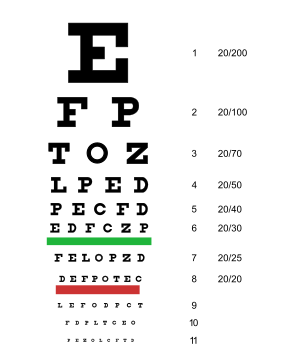
Once a year I have to go see the optometrist. Each year it’s the same old tests. “What are the smallest letters you are able to read?” To which I always reply, “I cannot read the big E without my contacts.”

I’m usually laughing as I mention it because I know it’s an E but it just looks like a blob. If it weren’t for contacts and glasses, I would have a hard time believing I would still be alive today. Tough to imagine that I wouldn’t have walked out into traffic or off a cliff by this point. Thank goodness for technology and for specialists who have been trained to help people like me attain eyesight. I wouldn’t be able to function through life otherwise.

While we all may vary in our level of independence, we all to some degree or another depend on others. That is unless your a hermit tucked back in the middle of the woods. But you wouldn’t be reading this blog post if that were the case….

Anyway, many of us see specialists to help us through all sorts of aspects of our lives. Doctors, financial advisers, and gym trainers are perfect examples. But they can’t do everything for us. Even though we oftentimes rely heavily on their expertise, we almost always still have a role to play. Doctors may recommend a treatment plan, but often it requires us to follow through on the recommended modifications and sometimes significant lifestyle changes to realize the desired health outcome. Financial advisers may recommend savings plans and investment strategies to get you to where you want to be financially in the future, but it requires discipline to stay to a budget and a commitment to achieve those financial goals. Gym trainers can encourage and push you through their recommended exercises to improve your health and conditioning, but ultimately you need to push yourself to actually complete the exercises and say no to that third Yum Yum Donut.

Our wants and needs drive us to pursue the assistance of others if we are unable on our own to meet our needs. We start planning for the future, knowing that we want to help pay for our child’s tuition in the future or save for a new house, and seek the assistance of a financial planner to get there. We go through the holidays and pack on the pounds and then realize maybe I should get a trainer to lose this weight and keep it off. Recurring illnesses or pain may drive us to finally visit the doctor for a diagnosis.

Until we recognize the need or want, the need for assistance is not evident. More often than not though, the earlier the need is recognized and corrective actions are taken, the greater the outcome in the long run. Establishing good financial, exercise, and health habits at an early age is of much more benefit than waiting until later.

So this got me thinking, what want or need are people like mentors, life coaches, psychiatrists and pastors addressing? And I’m not talking about the life coach who helps you brush your teeth and not act like a snowflake. I’m talking about the life coach who helps feed you the thoughts that drive you to push through the daily grind. To get up in the morning with a purpose and be able to keep pushing through life. Because it can be a grind at times.

Now I realize there can be significant differences between all of these people. There are substantially different qualifications for being a life coach, a mentor, a pastor, and a psychiatrist. But I think there is some significant overlap in the roles these people play in the lives of others.  Paul Vanderklay, a pastor who runs his own YouTube channel, which I would highly recommend, defined his role as a pastor as “helping people align their story with the story of others and the story of the Bible.” Now, this is not necessarily a post about pastoring. For the purposes of generalizing this for all mentors, life coaches, and spiritual leaders we could replace “the story of the Bible” part of his quote with “a framework or lens through which we see the world.”

Our story can be quite complex. There have been things within our control and many things out of our control. Highs and lows. Both comedic and tragic moments. Mistakes made and incredible feats accomplished along the way. Maybe there have been unrealized dreams or everything we could ever need has been handed to us. Each of our stories, though they may share some similarities, are incredibly unique.

The stories of others, although often hidden beneath the perfect facade of social media and our “put-together” behavior in public, often have many of the same elements that ours do. Pain, happiness, hardship, joy, strife, love, peace, war, injustice… The more you listen to other peoples stories and study history, the greater sense you get of how difficult and complex this world has been, continues to be, and always will be. A visit to the Holocaust museum or a brief study of the 20th century is all it needs to be overwhelmed with the heaviness of the human condition.

Today more than any other time in history we are confronted with, more often than not, the worst of the worst stories in the world. Mass casualty shootings, natural disasters, the spread of disease, wars, kidnappings and murders, sexual predators, corrupted institutions… At no other time in history have we been bombarded with the tragedies of life from across the globe with the frequency and explicitness we do today. It doesn’t take long to see the depravity of this world and how incredibly sad and difficult the stories of humans have been and continue to be.

And this is why I love how Paul Vanderklay defines his role as a pastor. In addition to knowing your own story and engaging with the stories of others is the need to have a framework or lens through which to understand these stories. For those of you who go to optometrists you are probably familiar with a phoropter. (Don’t feel bad if you didn’t know the name for it because I certainly didn’t.)

Closeup of medical equipment in an opticians clinic

The optometrist will continue to change the lenses in front of your eyes and check your vision to see how clearly you read the letters in front of you. The very first lens used usually provides a very low resolution view of the letters, but as additional lenses get added or changed, your vision should improve assuming your seeing an optometrist worth his or her salt.

Likewise, the role of mentors, life coaches, and spiritual leaders in our lives is to help us to find a lens or framework through which we can see our lives and the lives of others in the greatest clarity possible that we can. Easier said than done, because as I stated before this world is incredibly difficult and the more you study the human condition the more complex the framework and precise the lens must be for us to function well. I think more often to not, the emotional, spiritual, and mental turmoil we all experience is almost always due to dissonance between our story, the stories of others, and the framework or lens we are using to view the world.

Maybe we haven’t dealt with an aspect of our story and really gotten to the root of an issue. Maybe we’re so disconnected from others, that our story gets out of alignment of the shared human experience or we lose an understanding of others and what it means to relate with them. Or maybe our framework through which we view ourselves and others is incompatible with our life. Maybe the lens through which we view the world is directing us in a direction that does not lead to the betterment of our story, or to a life that is compatible with the rest of humanity.

Similar to the optometrist changing out lenses as they are determining our prescription, we can all be modifying our frameworks to try understand the world, and I think that’s so often done best with the assistance of others. As we talk through our lives and really dig into our perceptions of the world, the low resolution frameworks like happiness, popularity, power and money being the meanings of life will inevitably have to be replaced by higher resolution lenses through which we can see the world if we will ever be able to handle the complex and difficult stories that we all share. And who knows, maybe that new worldview that we adopt can take us beyond a state of just coping with the difficulties of life and extend to a greater appreciation of what existence has to offer.

We may never get a 20/20 vision of the world, but here’s to hoping we can all at least read the big E of life, whatever that may be, and continue to refine our worldview from there. And don’t be afraid to reach out to someone for guidance. We all need guidance whether we wish to admit it or not. Just like the optometrist is saving me from blindly walking into traffic or off a cliff, that person, or those people may help us from falling into the deepest pits of life. We have a role to play in figuring out our way but we weren’t meant to figure this out on our own.