The Chief Good

Inspired by Ethics by Aristotle.

It still hasn’t hit that I’m about to start my final semester here at Penn State. And the crazy thing is that there is still an unsettled feeling about the next step. But do we ever feel completely comfortable about what life brings next? Going from middle school to high school. The transition to college. Taking on a first full-time job. Switching jobs or moving. Marrying and having kids. I haven’t personally gone through all of these, but I believe I can say that at each turn in life, there are questions to be answered, doors to be opened, and big decisions to be made.

And as I look back, these past four years are culminating with this next step in life; leaving the “bubble” that is State College, to go into the “real world”. All of the classwork, internships, and research has been directed toward this next step. Upon reflection, I can say that my life these past several years has primarily revolved around this pursuit of a career I desire. But how much of my life should revolve around this? What am I striving for? And should I go through life simply taking it year by year with the end goal being the desired next step?

It’s officially 2013. And many take time at the beginning of each year to make resolutions or changes to themselves to make a stride toward a better future. But how deep are they typically? Usually they rarely get past the level of “I plan to remove Twinkies from diet” or “I plan to run a half marathon this year as a goal for getting in shape”. My point is not to diminish the importance of these changes but to suggest there are potential changes with very great importance.

Have you ever sat back and thought about what it was you were working towards in life? What would make you life complete? What would make your life worthwhile? Is it happiness? Is it success? Money? A relationship? A nice house?

Why does the pursuit of this deserve the investment of your life?

The Chief Good; an idea proposed by Aristotle, is the focal point of all of our effort, energy, time, and resources. That our entire lives revolve around this one thing that we are striving for. The Chief Good has to be the root of our pursuit. Therefore “happiness” cannot be a Chief Good because it relies on something(s) to provide happiness. The Chief Good is not vague but very specific.

Personally, I believe my Chief Good has been security. Risk rarely could be justified in my life, and taking chances was never something I was comfortable with. I wanted a job that would produce financial stability so that I wouldn’t have to worry about my level of comfort. I didn’t want to have to worry or be reliant on anyone else. Simply put, I wanted a smooth-sailing life. During these past couple years, I realized just how self-centered that was and that that’s not how life is meant to be lived.

And I’m making a conscious effort to try to change it. After much thought and reflection, I personally could find only one Chief Good in life that was a clear direction for me, and would provide pure completeness. I’ve realized that God is the center of everything and that I want to glorify Him in response to the the mercy He’s demonstrated for me. And other chapters of life fit into this greater storyline. At the end of my life, “completeness” will come from investing myself in ways that aligns with God’s plan for this earth and my life.

So what’s your Chief Good? What resolution have you made or are you going to make in 2013 and the rest of your years beyond? In the rush of life, sometimes a step back to see where we are going is needed. I hope you find that break early this year. Happy New Year everyone! I wish you all a very fulfilling 2013.

Excommunicate the Band Geeks

Visiting home for the weekend just a week ago, I got the opportunity to see a high school football game for the first time in three or four years. Ahhhh…. The glory that is Friday night lights. Hard to believe so much time has past, and well, after being at so many Penn State games, it was a little less exciting than I remembered in high school. And what had also changed, was my perception of the band. Alex, if you’re reading this, don’t be offended, but I did not remember being that well… “weird”. I mean, all high school kids there came across as weird, but it seemed different than when I was in it.

I remembered being one of the “cool” kids in the band. My friends and I always said there were two parts of the band. There was the cool group, us, and then there was the “band geek” part that was a poor reflection on the rest of us. They were the part that the rest of the school saw, which led them to label us all as “band geeks.” At times, I hoped that these individuals just wouldn’t be a part of the group because then the remainder would be a perfect representation of who we actually were, the “cool band” I envisioned.

But as it turns out, that’s all it was. A vision. A biased interpretation. A false reality. We were all “band geeks.”

Hold that thought: “Ben realized he was a band geek.”

Now, three days later, I was watching some election coverage. And let me just say, I think it’s impossible to watch politics and enjoy it. Politics always leaves me ticked off, which makes me wonder why I watch it in the first place. Anyway… CNN was discussing Romney’s faith as it relates to his platform on homosexuality. They had five gay and lesbian individuals on camera talking to the reporter about how their churches had either excommunicated them, or would if they found out about their sexuality. My only thought: Where is the acceptance?

Christians and non-Christians alike I’m sure have heard of this type of nonacceptance within the church. This isn’t an issue solely about homosexuality. It’s a greater problem that we need to be aware of. Some individuals, even on the basis of appearance (tattoos, piercings, hair color) find closed doors at their local church.

When I was in the high school band, I saw others in the group as less than myself at times and wished they weren’t there. I thought, “Excommunicate the band geeks.” This sounds terrible. Even I see that now. But haven’t we all thought this at some point?

Maybe you’ve been on a sports team where you felt a certain individual held you back. A team member on a project, that you felt didn’t produce as good of work as you. Or a coworker who wasn’t as skilled or as smart as you. Did you feel that they should have been cut from the team, kicked out of the group, or fired? I think to some degree we have all felt this.

In our nature, we like to think highly of ourselves. Our morality. Our strengths. We may not consider ourselves the best, but we always look for someone “worse” to compare ourselves to. More so than we should. The same goes with Christians. Do we always see ourselves for who we really are? Not at all. We fail to identify with the lying, greedy, prideful, angry,  and just plain broken and messed up people that we are. And the church needs to identify with it’s real identity as well. It’s not a museum for the perfect. It’s a hospital for the sick and weary.

The thing is that in the band, we were all “band geeks”. And you know what? I’m fine with that. Same goes with Christians. We are all messed up people. And some individuals you meet will acknowledge this and some won’t. Some churches know identify with the reality, and some don’t. You’ll never find perfection though, because well, how can you build a perfect group from imperfect people?

I want my friends and family to feel comfortable coming to church. I want them to know what Christianity is all about. It’s not about putting up a facade of righteousness and perfection by keeping out those we consider less. It’s about keeping the door open, extending a hand, and letting them know Christ who was perfect and is still willing to live with and die for, us, even while we actually do fall far short of Him.

The Cardboard Box

What if you lived in a cardboard box from day one of your life with a few other people who have also lived there since birth? All you can recall is the plain brown inside of this cubicle you call your home. You can’t hear anything outside of it and you don’t know how you got there in the first place. You can’t leave it, and because you don’t know of what is outside of it, you have no desire to leave.

Seems like a bizarre scenario right? I mean, for us to go spend time in a box ourselves right now would not help us understand this scenario because we already know what is outside of it. But humor me, and give this some thought as we switch gears…

We pride ourselves on knowledge. Our society’s hierarchy is very, very, closely related to your amount of education, how much knowledge you possess. These individuals deemed “intelligent” or “bright” or “a genius” run many of our corporations, universities, organizations, heck… even the government as a whole.

Wait just a second. Is he saying that these smart and knowledgeable individuals shouldn’t be in these positions? I’m not saying that at all. All I am saying is that we as a society put those who are intelligent on pedestals at times, and when a particular trait is highly regarded like this, it can lead, not always, but oftentimes to pride and arrogance. I can attest to this myself, putting a lot of my identity in my academic success here at Penn State.

We compare ourselves to our classmates, our coworkers, our family on the basis of how much we know about particular subjects. We get into heated debates with the sole purpose of being considered “right” at the end of it. And our perceived wealth of knowledge can keep us from seeing more, and understanding more. What if our own intelligence is a hinderance?

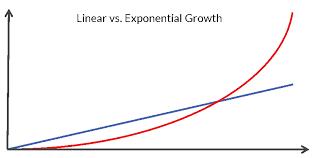
Don’t be scared off by the graph. I just think this helps to visualize this idea.

Let’s assume that our growth of knowledge is linear over our lifetime. We continuously take in information and gain a greater appreciation of what is around us. We will learn a lot in our lifetime; everything from the alphabet, to how to use computers, to how to work with people, to how to love. But let’s also consider what the exponential line represents.

It represents our knowledge of what we don’t know. That as we go through life, the complexities increase from will I be fed or get that toy for Christmas as a kid, to why is there so much pain and suffering in the world, and why when I try to be a good individual, do I still fail. I came to Penn State thinking by senior year I would be ready to understand the world. Here I am now, and I realize that I’m just starting to learn so much about this life, and that for every thing I learn there are infinitely more things I realize that I still don’t know.

So let’s switch the gears back. How does this cardboard box come into play?

If I were to study the inside of the cardboard box for my entire life would I learn anything about the outside of the box? Could I run experiments, tests, or conjure up a hypothesis that would explain the reason for me being in the box, or existence at all? I would argue that the only two things that could be concluded is that one, I exist. And two, something created the box, or the box came from somewhere.

In this world, our own perception and knowledge can only go so far, despite the fact that we want to be able to explain everything. We need to humble ourselves to realize we really don’t know as much as we think we do, and as resistant as we may be to admitting that ourselves, it remains true. 

From a practical standpoint, realizing how little we know will free us to learn more, not be shy to ask questions, and allow us to avoid plateauing in our lifetime journey of education. But I think there’s something much greater many of us may be missing out on.

Consider this last addition to the scenario. What if a note was given to you claiming to be from the outside that explained the existence of the box and you? What if this note explained a greater meaning for life than just a plain existence inside a cardboard box? Would you read what it had to say, or listen to the others inside the box who say, the cardboard box is simply a box and nothing more?

I didn’t believe in Christianity because there were individuals who had made claims that it’s not scientifically possible. How could Jesus raise from the dead? No one has ever defeated death. And how could so much evil be in the world if God is supposed to be so good? Wouldn’t the world be perfect if He existed? I studied the inside brown wall of my life and I couldn’t see how the stories I heard about this note made sense with what I saw.

But I had not actually read the story. I did not know what the note said and therefore did not know the reason for my life or the box. The issue is that if we try to make God fit our own expectations, and don’t read His story, then we will always come to that conclusion that he can’t exist. Our perception is not everything. The truth is not relative, and it may go against what we like to believe.

If we take a step back, and consider, “maybe I really don’t know everything,” and take some time to see what the story of the Bible is saying, we’ll find answers to other questions that human intelligence can’t provide. Who knows? Maybe it will give you a better appreciation for the cardboard box, and what’s outside of it.

Lies, Lies, Lies…

“You’re not smart enough.”                  

“You need to cheat to get a good enough score.”

“You’re ugly.”                                                      

“You are going no where in life.”

“You aren’t skinny enough.”

“Nobody likes you.”

“No one would miss you if you left.”

“You have to drink to fit in”

“You will never be successful.”

“You will never be able to lead this group.”

“You can’t do it.”

“Your relationship status indicates your worth.”

“You’ll never get that job.”

“Life does not get better.”

“That person deserves to be put in their place.”

“You are worthless.”                            

It’s amazing how many lies exist in our lives. They originate from all directions: the TV and movies we watch,  the books and magazines we read, and generally it all stems from the lives we live. Constantly acting as an impedance to our walk in life, these little fibs can cut deep, heighten pain, and cause us to act in some cases, and in others, leave us mentally depleted.

And yes, all of those lies listed above do not apply to everyone, but I am guessing that at some point or another, at least one rings true for everyone’s life. And it’s very likely that one is causing all of us grief and pain right now.

It can be so difficult for us to see them for what they are when we are actually hearing them. They intertwine themselves within our own thought processes like they are one of our own. We consider them, without recognizing their origin or even how false they actually are. And they remain only lies until we submit to them, believing them and acting on them. That’s when they become dangerous.

They can lead to jealousy, depression, anxiety, anger, entitlement, slothfulness, and even pride and greed. Yes, the above listed lies are all negative, but lies can also be too positive and self-centered to the point of being dangerous. Dangerous to the point of pushing loved ones away, and distancing ourselves from a humble and fulfilled life.

As we think back to our greatest struggles and toughest times in life, aren’t lies often the root of our greatest hindrance to moving forward in life? So how do we make progress when facing these tempting falsehoods?

First, we need to remember that it was through a lie that sin and suffering entered this world. 

“Now the serpent was more crafty than any of the wild animals the Lord God had made. He said to the woman, “Did God really say, ‘You must not eat from any tree in the garden’? ”The woman said to the serpent, “We may eat fruit from the trees in the garden, but God did say, ‘You must not eat fruit from the tree that is in the middle of the garden, and you must not touch it, or you will die.’” “You will not certainly die,” the serpent said to the woman. “For God knows that when you eat from it your eyes will be opened, and you will be like God, knowing good and evil.” When the woman saw that the fruit of the tree was good for food and pleasing to the eye, and also desirable for gaining wisdom, she took some and ate it. She also gave some to her husband, who was with her, and he ate it.”
                                                                                                          – Genesis 3:1-6 –

The temptation of Eve by the serpent in the Garden of Eden was the push that got Eve to disbelieve God’s commands. She knew what was true, what God desired of her and commanded. But in weakness in conjunction with an insisting lie, she decided to eat from the tree of knowledge of good and evil, disobeying God and causing the fall of man. Lies are precursors to sin.

And second, we must know that hearing lies is not a sin in itself. Lies can lead to sin, but it does not always end this way. There is no question that we are all confronted with this deceit in life but the question does remain “How do we respond to them?”

Even Jesus was tempted. Living a perfect life, He was tempted by Satan to turn stones into bread to end His hunger during the forty-day fast. Satan also tries to tempt Him by offering dominion over all the kingdoms of the world (Matt. 4: 1-11). But Jesus doesn’t give in to, I would argue, the biggest temptation in the history of man. He was offered the world and given an option to not die a gruesome death for our sins and yet He is unwavering. He commands, “Away from me, Satan! For it is written: ‘Worship the Lord your God, and serve him only.'” And Satan left Him.

So how do we respond when we hear voices saying that we’re not thin enough or strong enough, or that we’re not capable of succeeding or persevering, or that we’re not loved? We have to realize that if we believe these twisted mistruths they become reality, can hurt us and those around us, and can lead to further actions that can cause even more pain. They become cyclical, worsening and worsening the more we buy into them. We need to recognize them for what they are and bring them to God in full reliance on Him.

Many unknowns exist as I prepare for the next big step in life. And I constantly hear lies about how the next chapter won’t be successful or that my life is not going to fall into place. At times, I believe them, and I worry, which separates me from a faithful walk with God.

But I’ve realized these big steps are occurring all the time and aren’t constrained to my senior year of college. Every day we are face-to-face with decisions, and ones that are influenced by the thoughts we have, both truthful and deceitful. We make decisions about friendships, leadership roles in work, clubs, or organizations, career decisions, what we decide to eat, drink, and wear, and how we perceive ourselves.

The fight is inevitable, so how do we combat this deception? Do we give in to those hidden lies that prod us into taking the paths we are trying to avoid, or do we recognize them for what they are, bringing them into the light, becoming stronger and victorious? It’s a choice.

Chick-fil-A: Shedding Light on a Divided People

Who knew the statements of the president of a chicken sandwich serving restaurant could cause such a divide in our country? We’ve seen recently the horrific actions of one man shatter our community, but know the speech of one man is causing an uproar across the country? Lately we’ve seen how the American society is like a weathered bridge. It’s fine when a few cars go over it, but the second a moving truck or semi comes along, the cracks become evident. We have some serious flaws we need to work on.

One, we need to be informed on what’s actually said and how it’s said. 

We are very much supportive of the family — the biblical definition of the family unit. We are a family-owned business, a family-led business, and we are married to our first wives. We give God thanks for that.We operate as a family business … our restaurants are typically led by families; some are single. We want to do anything we possibly can to strengthen families. We are very much committed to that.We intend to stay the course. We know that it might not be popular with everyone, but thank the Lord, we live in a country where we can share our values and operate on biblical principles.”
                                                                                                                                            -Dan Cathy, COO of Chick-fil-A-

This does not sound very hateful. He expressed his opinion in a respectful manner and held to his beliefs. I hadn’t heard his initial comments until I took the time to dig for them. We are fed snippets, soundbites, and short paraphrases of what’s actually said or done. We need to filter what we hear and see.


Two, there’s a huge difference between hating someone (discriminating) and disliking what they do. Dan Cathy was holding to what he believed in, the validity of the bible. And it says,
“You shall not lie with a male as one lies with a female; it is an abomination.”

That being said, our two greatest commandments come from Matthew 22 when Jesus said, “Love the Lord your God with all your heart and with all your soul and with all your mind. And, love your neighbor as yourself.”

So there’s a conflict there. We’re told it’s wrong but we are told to love everyone.

I had the privilege to meet a manager for a local Chick-fil-A and he donated a large sum of food to an LGBTA event this past year, because he cared for the group and wanted to reach out to them. Another story I heard recently was that of coworker’s friend. She is a lesbian, and went to Chick-fil-A yesterday with an “I’m Gay” t-shirt on. And she was delighted when they served her with a smile on their face. She didn’t agree with him, but she respected the way Dan voiced his opinion and the strength he exhibited.

You can love people, and not agree with what they do. We all make mistakes and sin. I don’t agree with underage drinking but I care for all my friends who do. The reason this is such a tough issue is that homosexuality is so visible. It’s easy to spot two men or women holding hands in public, whereas, stealing, lying, and adultery are kept more in the shadows.

Regardless of the degree of visibility, it is possible to combine the two, and sadly we’re not hearing that in the discussion of this issue and it’s preventing healthy discourse.

Lastly, leaders in the roles of upholding and enforcing laws have to have backbones and honor our freedoms. Mayors stating they won’t allow Chick-fil-A to build in their cities are allowing the opinions of one group while punishing another group for their opinions. Lately, many leaders (cough cough Penn State administrators, NCAA president, and politicians) are trying to be so politically correct and concerned with the opinions of particular groups, that we restrict the freedoms of others. To say that no one will get hurt in a “free” society is not being realistic.

“The cost of freedom is always high, but Americans have always paid it. And one path we shall never choose, and that is the path of surrender, or submission.”
                                                                                                                       -JFK-

All that to say, I’m glad Dan Cathy voiced his opinion. It has brought to light the issues that already existed prior to his statements. Many are scared these days to voice their opinion, even if they have good reason for believing in it. We need to remember how we interpret what we see and hear, remember that this country is founded on freedom, and that we can disagree with a person’s actions and still love the person.

I hope we can push forward and in ways, revert back to the roots of this nation. We heading down a slippery slope right now if we can’t have healthy debates and respect the freedoms of others. And, running out to support or protest Chick-fil-A is not going to change this (although I am feeling a chicken sandwich and waffle fries right now). It’s not about the definition of lines between us. It’s realizing, like in those stories above, that we can reach across them, see eye-to-eye, and still care for each other despite our differing beliefs.

Lunch and Learn

This summer, I have had the privilege to work with some absolutely amazing coworkers. And just like any job we have, the end goal is to look back and have something to take with you going forward. There are many things I can take from this summer; and many of them aren’t environmental engineering-related at all. And that’s the beauty of these past few months. I will be applying so much of the lessons I’ve learned in any path I may choose to take going forward. And here’s one that I have to pass along to you, my friends and family.

About a month ago, my supervisor held a “Lunch and Learn” session for the engineering, environmental, and health and safety team. In the middle of a busy time for him and the group, he ordered us pizza and paid us our hourly pay for the time we spent with him in the company’s conference room. The whole reason for this special meeting, was to take time to watch a video and reflect on how we were living our lives outside of work.

In my four summers of working, I’ve been privileged to have great bosses. I look back at all of them and see many great traits that I admire and want to embody myself. But this decision to invest in the lives of your coworkers as a leader is the most memorable from this summer (so far). Everyone in my department was really touched by his act of taking time to invest in their lives. People are always more important than any piece of equipment, meeting a quota, or any amount of profit. Yes, these must be pursued in business, but he realized that what is most important is taking a little time to step back and refocus on what life’s all about.

He decided to share this video with us and I encourage you to watch it. It’s Randy Pausch’s “Last Lecture” at Carnegie Mellon. He has terminal cancer and shares many of his life lessons in his last opportunity to speak wisdom into those closest and most important to him. This story had really impacted my boss and sharing this  with us, was his way of showing us that he cared.

So please take some time to watch this. You won’t regret it. And think to yourself, “Is there a way I can show my care and concern for those I lead?” I can attest to it personally, that it fosters the relationship and could be exactly what they need from you.

And if you enjoy this, I highly suggest reading the book “The Last Lecture.” It has several additional stories and lessons that we’re not included in his recorded lecture.

No Clean Cut

The results of Freeh’s investigation on the “Penn State Scandal” have troubled me to the point where I have a hard time figuring out what to feel or think. And it’s not just the findings listed in the report, but the way everyone is reacting to the news. I really think most people are conflicted inside like me, between outrage, skepticism, loyalty, disgust, and handfuls of other emotions. Over the past several months, consistent with how I try to approach many situations, I try to give others the benefit of the doubt. But being optimistic, only prolongs the pain when the worst of the worst is in fact the reality.

It sickens me that men, trusted to make the best decisions, failed those kids and failed miserably. The leaders of a football program and school that preached the importance and need of integrity and the moral pursuit of success in athletics and academics, didn’t practice their own lessons. And now, we are faced with how to react as we go forward.

In less than two months, assuming nothing unexpected occurs, I’ll be marching into Beaver Stadium, the iconic reunion place for much of the Penn State family, only this time, it’s going to feel different. It’s not going to have the perfect, innocent, and joyful feeling it’s had these past three years. It’s a new beginning, a sad beginning. And it will never be the same. Having these acts brought to the light illuminates a number of issues beyond the abuse that occured; issues that can’t be fixed by any coach, president, court, or law enforcement.

It only takes one man’s actions and transgressions to bring out the worst in humanity. Within the past year we have seen it here in State College. There aren’t words to describe how sick Sandusky’s actions and crimes are. But think about our reaction to these terrible deeds…

Four days after the initial release of Sandusky’s charges, Joe Paterno’s is firing led to an unnecessary and ill-advised riot in downtown State College. Students flipped a news van, shouted chants like “F&%# the media!” and start fires on the lawn of Old Main all in protest of a decision we as students had little to no knowledge of the reasons for. Why was destruction needed? Why did students cuss out media members who were simply doing their job and played no role in the firing decision or sexual abuse in the first place? It’s because we as students also failed in upholding the standards. We did not possess the integrity we prided ourselves in as Penn Staters.

Millions across the country, then jumped to conclusions on individuals’ involvements, motivations, and innocence or lack there of. It became a witch-hunt, people throwing others under the bus. This was all in an attempt to either make themselves look better in comparison to those who were accused of making bad decisions or just for the sake of jumping on the bandwagon. Our whole campus was guilty by association because of the transgressions of a few who shared ties to the same institution. We as a society run for our pitchforks and torches at the sound of an accusation.

No one was thinking for themselves, and out of the “care for these victims” that so many pointed to to justify their reactions, they condemned others and acted heinously as well. Reading the comments on ESPN.com articles (a terrible idea I might add), I would constantly find messages with a combination of hope and prayers for those victimized and distasteful jokes about or threats to those involved. How does this make any sense? How can those two things come from the same heart and mind?


These drastically mixed feelings led so many to judging the eternal destination of these individuals. A visible example of this came from ndulge, a dessert shop downtown. They posted these signs earlier this year and many students celebrated their move to present these in their windows.

We are in no place to judge the eternal destination of others. It resides completely in the personal relationship with God, and although actions can point to the health of this relationship, ultimately He is the final judge. In a decision that isn’t based on a ratio of good vs. bad within us, but our faith in Christ, who are we to make such bold statements.

And what about the large number claiming they would have done something different? If they were in fact correct in their statements, wouldn’t we be living around an overwhelming number of moral and ethical people? I look at myself, and realize I’m not perfect. I look around in this college environment and I see so much that is just plain wrong with it. I’m starting to feel like these deficiencies in humanity are more prevalent than we think, and we overstate our goodness and understate our failings and badness.

I want to think if I were to ask any of these men, they would say with hindsight that they would have done things differently. So everyone has 20/20 hindsight. Who are we to say that in someone else’s shoes we would have done something different? We can only make sure to do our best in the future when presented with a tough challenge like this.

The truth is this world is broken. People do terrible things, and in reaction to these terrible things people do even more terrible things. I’ve wanted this whole case to wrap up, get closure, be learned from, and go in the past. But sadly, it won’t.

There will be questions unanswered, facts that will remain in the dark, and despite this coming to the light, child sexual abuse along with many other horrendous acts will continue. Crimes will go unpunished, innocent individuals will have the quality of their lives compromised and diminished, and fingers will continue to be pointed in the aftermath, both at those justly and falsely accused.

So, sorry that you had to deal with my rambling. I just wanted to share some of my observations. I’ve definitely played a role in some if not all of these issues in some way or another. And despite my thoughts and feelings, I still don’t know what to think of all of this. I’m constantly conflicted with my lack of knowledge on everyone’s motivations, thoughts, and hearts. I simply don’t know all the facts, and I am disturbed by everything that has to our best knowledge occurred.

I try to hold on to this little verse through all of this.

“Let the man without sin cast the first stone.”                                      – John 8:7 –

We need to think before we act in the wake of another’s mistake. Otherwise the cut never heals, it only gets deeper, and the bleeding gets worse.

MISSION: Speed Limit

Driving from State College to Roaring Spring everyday and then driving home several weekends, I have been logging thousands and thousands of miles and hours upon hours upon hours of time on the road. With all that time, you’re bound to analyze, and maybe over-analyze certain things. It even brings back weird memories, like the time I saw a 9 1/2 mph speed limit sign.

And this random thought got me thinking… And after lots of thought, I came to the conclusion that our speed limit system is a little bizarre, for lack of a better word.

I find it hysterical that very few people actually follow this law of the road. We, in general, drive 5, 10, or sometimes more mph over the limit, keeping our eyes open for cops who hide alongside the road, attempting to catch those surpassing the allowed speed.

I would always find myself surprised when watching a pursuit on TV, how we would send 4 or 5 cops in pursuit of one speeding car. So instead of 1 dangerous driver on the road, we would have 5 or 6 speeding drivers on the road? This doesn’t make sense.

Safety is the primary reason for instituting the speed limit. They are intended to give suggestions for roads, to inform riders of the safe speeds which they can travel. They also should be enforced as a way of keeping the safety of others on the roads at the forefront. But from the looks of it, I would say we’ve lost sight of the motivation of the law. We’ve forgotten, drivers and enforcers alike, that the motivation for creating the speed limit was to prevent crashes, and ultimately fatalities.

I’m no exemption from this. I’ve found myself driving faster and faster this summer, as I’ve grown frustrated with the amount of time I spend on the road.

And no, I’m not actually going to talk about how we shouldn’t speed. I think it’s an important subject, but I’d much rather look at the greater issue. We have a moral code that’s inscribed within us that we are to live by to be safe and not harm others. A code that tells us, consciously or subconsciously, what’s wrong and what’s right. 


And this moral code consists of things like:

-Don’t Lie
-Help Others in Danger
-Don’t Steal
-Save a Life if You Can
-Don’t Envy
-And many, many more…

So I equated speed limits to moral codes. And, I set a goal for myself. A mission to drive from home to State College, a 3 hour trip, at the speed limit.

And, I almost succeeded, failing on a few occasions. At the times I found myself speeding, I evaluated the root of it and here’s what I’ve found after a ride that took only 20 extra minutes and probably ticked off a couple drivers…

1) It’s harder to follow the speed limit on a two-lane highway, because you feel the added pressure of others opinions behind me. Watching a 20-car line in my rear-view mirror on 322 going into State College definitely made me want to speed, but unfortunately for those drivers, I held to the limit.

2) When you’ve established a habit of speeding, if you’re not consciously trying to change it, it will just happen. One minute I was driving 65. The next, I was passing cars who were going the speed limit, because I had forgotten my desire to break the habit.

3) Limits can seem, well… limiting. They can come across as a “fun-reducer” or an unnecessary hassle. We feel the urge to break them because we feel like we would be missing out on valuable time if we abide them.

4) We try to justify ourselves. “Well everyone else is doing it.” Or, “I’m still a safe driver.” Or, “I’m in a hurry.” We hear these lies that convince us to push and exceed what we’re told not to do.

5) When we enforce a law, or judge someone for their immoral decision, we fail to recognize the deeper need. Cops are pulling people over for speeding, and demanding a ticket in compensation for the act. I really don’t think that safety comes into play on all occasions.


So what to take from this…

If we’re concerned with others’ opinions about our decisions to do the right things, realize that it’s not our problem how they respond. Sure, we might be affected by it, but the bigger problem if they respond inappropriately, resides within them.

If we have bad habits, we have to be conscious all the time to combat it. Recognizing the trigger or cue for the habit and the “benefit” received from the act can help to break it.

Laws and rules can seem restricting, but in fact they’re quite freeing. I’ve heard many people talk about legislation as well as religion and faith as being restrictive. I can’t say that 100% of legislation has the right motivations, but I can say that for the Bible. The law in the Bible is given to us as guidelines for living a fulfilled, happy, and Christ-centered life. We’re told to not lie, steal, lust, harm, or slander because God doesn’t want us to damage our relationships and lead a life enslaved to these damaging habits. It’s motivation is 100% spot on.

Watch out for the lies your told. Many things will encourage you to take the easier road of committing the illegal or immoral act. Fight it, and stop it at the root.

And lastly, when someone else is struggling with an immoral habit, look out for their well-being and really try to help them end this cycle. They can do serious damage to themselves and those they love if they continue. Don’t judge them for their decision; try to provide help.

So I challenge you next drive to go the speed limit. I used the extra time on my drive to really consider what I have struggled with. And it was the best drive I’ve had in a while. If you do drive the speed limit already, think about why you do. Is safety really your motivation? And the greater question… Are we concerned for the well-being of our friends, family, and selves the motivation for following our moral code? What habits have us pushing the limit, and when will it finally catch up with us if we don’t break it?

The Manila Folder

Have you ever had a conversation with someone that you knew as it was unfolding, would be one you would never forget? A conversation that would be life-changing because its message was exactly what you were looking for at that time? I was blessed to have one this past week with a great man, a fellow co-worker, Rob over lunch at a small local pizza shop.

With his mother passing away when he was 6 years-old, Rob’s father was left to raise seven kids on his own. Working a majority of his day at his bar and also an alcoholic, his father pretty much left Rob and his siblings to figure life out on their own. Rob struggled in early jobs to support him and his wife, and went to school late, only to have setbacks in finding jobs with his degrees.

He shared with me a piece of advice. “Don’t let life happen to you. Make life happen.”

He thought of this 15 minutes before quiting a previous job because it was stagnant. He wasn’t learning anymore. He wasn’t growing. He was letting life happen to him and always felt a step behind on pursuing dreams in life. In fact, he wasn’t really sure what his dreams were. So those last 15 minutes before walking up to his boss to inform him of his decision, he took a pad of lined paper and a pen and started writing.

After lunch, when we got back to work, he opened the bed of his truck and pulled out a manila folder for me to see. It contained drawings, doodles, and a list on this lined pad paper he had mentioned during lunch. It was a list of roughly 25 dreams he wanted to accomplish. A bucket list essentially, but it listed everything from being a handyman, to writing a children’s book, to inventions he had ideas for, to creating a 3-year teenage Sunday school lesson plan.

And he’s been going after them. He worked as a handyman for 5 years, doing small-scale construction work for many different people. He enjoyed the opportunity to help out so many different people. After finishing his job, he would ask to share the gospel with his clients.

He even wrote a children’s book. He’s almost finished it. It’s titled “Duck Book” and it’s meant to be a tongue twister for kids.

As I look forward to this last year at Penn State as an undergrad, I wonder what’s next and I put so much emphasis on the importance of a few big decisions, in similar fashion to Rob’s focus on finding the perfect job. In fact, looking back, so often the pursuit of the next step in life has constantly clouded my vision from pursuing other dreams.

When I was growing up, I wanted to be a fry-cook at McDonald’s.

I wanted to be an engineer (for a train) because that’s the type of engineer I thought my dad was and I thought that was the coolest thing.

I wanted to marry Cinderella, and I made some moves. She was digging me, but I just wasn’t ready to settle down yet. The long distance relationship would have been tough with me in Baltimore and her staying in Orlando. And don’t get me started on how jealous Prince Charming was and how difficult he made things.

I wonder now, where have these child-like dreams gone? Maybe not these dreams specifically, but dreams in general. Have I pushed aside the pursuit of the simple pleasures in life, for the chase of bigger more important things?

If you’re like me, sometimes the “big decisions” can keep us from experiencing the best parts of life. It’s like driving down a highway and failing to observe and enjoy the beautiful scenery along the way. 

I know over the rest of this summer, I’m going to start my own list and keep it in a manila folder to remember Rob, a man who took the time to share his story and dreams with me. It’s made a big difference in his life, and it was important enough for him to want to pass it along. 

So who knows, maybe I’ll end up at McDonald’s at some point cooking fries, or maybe I’ll end up saying “I Do”s with Cinderella, but in all reality those aren’t my dreams anymore. They change as we change. Regardless of whether or not they actually happen, recognizing your aspirations and the pursuit of dreams is an important part of keeping it light and fun while making life happen.

So what’s in your manila folder?

Needed?

I really miss those weeknights under the lights, playing soccer against county rivals back at Daniel Boone High School. I was never a natural at soccer, and it was a sport I really had to work at. Not the most agile, I can remember running hills, doing plyometrics, and just trying to be an asset for my team. I didn’t start varsity until my senior year, but it was so rewarding after working hard throughout high school. I finally felt like I was contributing.

At work, it’s been very similar. I’ve always felt self-conscious of my work quality, or not worth the money they’re paying me until I heard from coworkers that I was in fact doing a good job. That recognition is exactly what I’m looking for to get settled, but without it, I always feel this need and strong desire for the approval of others.

Even when it comes to clubs and organizations, I’ve always been driven to give as close to everything as I could give. Burning myself out just to get the feeling that others “needed” me. I wanted to feel that my existence made a difference; that if I left I would be missed, or things wouldn’t be as good. And maybe I’m the only one that feels like this, but I think this is a void that we feel inside and constantly try to fill with the recognition of others.

Recently I was really intrigued by the story of Samson. It’s told in Judges chapters 13-16. I would highly suggest reading it. It has lions, honey, and three-hundred foxes tied in pairs and lit on fire. How can you not enjoy it.

But in summary, it tells the story of the last judge of Israel who was born to take the lead in God’s plan of delivering the Israelites from the Philistines who ruled over them at this time. He was born a Nazirite, dedicated to God from birth. He is the only man in the Bible with the power of extraordinary strength, and an angel tells his mother that this strength doesn’t fail as long as his hair remains uncut.

Being a Nazirite, Samson is forbidden from particular things. Looking at Judges 6: 1-8 it says in Ben’s Shortened Version (BSV),

“That if a man or woman is to make the Nazirite vow, a vow of himself to Yahweh, he will abstain from wine and fermented liquor, cut his or her hair, or go near a corpse.” Interestingly though, as a man dedicated from birth to God, we see Samson participate in many “unNazirite-like” actions:

1. He marries a Philistine woman.
2. He goes back to the corpse of the lion he kills when it attacks him.
3. He uses the “fresh” jawbone of a donkey (another corpse) to strike down a thousand Phillistines.
4. He sleeps with a prostitute.
5. He is blinded by women to the point that he gives up his secrets to them, including the secret of his strength that resides in his hair remaining uncut.

In conclusion, the Philistines cut Samson’s hair and yet in response we see him say in Judges 16: 20 “‘I’ll go out as before and shake myself free.’ But he did not know that the Lord had left him.”

Do we reside in our own abilities to try to accomplish God’s will? Do we think that our strengths are our own? Or do we somehow think we can make God feel like he needs us?

Samson’s strength remained, despite his countless sins, but it is when he fails to recognize his own need for God, he is left powerless, abandoned by the Lord. Samson’s eyes are plucked out as he is captured by the Philistines, leaned up between the two pillars that supported the temple and was harassed. He prayed to God for the last time in verse 28 “Sovereign Lord, remember me. Please, God, strengthen me just once more, and let me with one blow get revenge on the Philistines for my two eyes.”

And God listened, providing Samson with his strength again. With all his might, Samson pushed the two pillars over killing thousands of the Philistines in the temple, fulfilling God’s will of helping deliverer Israel from their hands.

I’d like to share the important messages I’ve drawn from this amazing story:

1. There’s a difference between God’s “perfect will” and “permissive will.” He wants us to do the right things, and live sinless, but because of our brokenness, perfect is not achievable. He still remains with us though as long as we don’t think take it upon ourselves and diminish His role in our lives.

2. God will fulfill His will regardless of what we do. That might make us think we can kick up our feet and chill but I think it makes point 3 important.

3. God doesn’t need us. He’s the perfect storyteller, working through our mistakes to fulfill his plan. Yet, it’s amazing how often we resort to idolizing “our own” strengths as if we’re contributing, and making God’s plan better than it was before we came along.

Our personal relationship with Him is what is important for us. We experience Him by pursuing his perfect will, loving others, taking leaps of faith, and living radically for Him. He loves us, and gives us a great amount of freedom to play a role in his redemptive story just like Samson, which is very uplifting. It’s not about us. It isn’t about how “needed” we feel. It never was and never will be. It’s just about Him, and how He has, and is, and will continue to prevail.

So lets take the pressure off ourselves to contribute and let’s enjoy the grace, mercy, and freedom He’s poured onto us. Let’s serve Him, not to be recognized, or “earn” salvation, but out of our love for Him.