“God chose the foolish things of the world to shame the wise; God chose the weak things of the world to shame the strong. God chose the lowly things of this world and the despised things—and the things that are not—to nullify the things that are, so that no one may boast before him.” 1 Corinthians 1:26-29
The Hunchback of Notre Dame, is a woefully underappreciated masterpiece. The score, the animation, and the storyline are woven together to produce a film that is inspiring, convicting, and haunting in a way so few works of art accomplish.

The deep and difficult topics, such as religion, lust, and unrequited love were bravely included by Disney’s Animation Studios, which more recent films lack. Their movies today seem to miss the risk-taking and profound themes that made them so popular in the past. And despite Disney’s recent propensity for revisiting their older classics, as the composer Alan Menken said in a recent interview, there appears to be a unique holdup with a live-action remake of The Hunchback of Notre Dame.
This movie is controversial to many, in large part due to its dark themes. And given the pushback Disney has received of late on many movies, it probably shouldn’t come as a surprise that executives would be hesitant as to whether or not to pull the trigger on a remake. Because it’s not just Disney that has lost its appetite for stories that might be challenging. The general public has as well.
But sometimes dark elements are necessary in stories. There are some who theorize that Disney’s lackluster productions of late are due to a drop off in the quality of their villains and I think there’s substance to that theory. For many of Disney’s best movies are driven by their villains, and Claude Frollo just might be Disney’s most terrifying one.
As the jester states at the beginning and end of the movie, “This is the tale of a man and a monster.” As a kid, one would assume the man would be Frollo and Quasimodo was the referenced monster. But the theme that permeates this whole story though is how Quasimodo, a disfigured man, was able to reveal the monstrosity that was Judge Frollo. The lowly, foolish, and seemingly weak man shames the seemingly wise and strong monster.
The Most Oppressive Tyranny
As the opening song to the movie “The Bells of Notre Dame” states, “Judge Claude Frollo longed to purge the world of vice and sin. And he saw corruption everywhere except within.” This particular temperament was one C.S. Lewis had identified and was so poignantly able to describe in his own writing.
“Of all tyrannies, a tyranny sincerely exercised for the good of its victims may be the most oppressive. It would be better to live under robber barons than under omnipotent moral busybodies. The robber baron’s cruelty may sometimes sleep, his cupidity may at some point be satiated; but those who torment us for our own good will torment us without end for they do so with the approval of their own conscience. They may be more likely to go to Heaven yet at the same time likelier to make a Hell of earth. This very kindness stings with intolerable insult. To be “cured” against one’s will and cured of states which we may not regard as disease is to be put on a level of those who have not yet reached the age of reason or those who never will; to be classed with infants, imbeciles, and domestic animals.“
C.S. Lewis
As C.S. Lewis rightfully remarks someone of Frollo’s character, would create hell in his own pursuit of heaven. This behavior isn’t limited to the religious, but to any person who believes in their own heart they are blameless and sees wrongs necessary of correction exclusively in others.
However, there’s certainly an extra level of horror when those committing atrocities do so in the name of God. That’s probably why Disney chose to change Frollo’s role, which was originally as an archdeacon in the book, to simply a Parisian judge. For when corruption runs that far up the hierarchy, it gets incredibly unsettling, and no doubt Disney would have received additional scrutiny from Catholics for suggesting such degrees of misdeeds so high up within the Catholic Church.
And yet, this world has seen corruption run all the way up into the priesthood, and not too long ago. And even in Protestant denominations, the recent controversies around leaders such as apologist Ravi Zacharias or Hillsong pastors Carl Lentz and Brian Houston show, those in the highest positions of church authority, can find twisted justifications for their actions. The Hunchback of Notre Dame is haunting because it rings true in our experience.
As C.S. Lewis notes in his wonderful book The Great Divorce, “It is a stronger angel, and therefore, when it falls, a fiercer devil.” We often shy away from those things that are most distressing, but that’s only because they originally were supposed to be really beautiful things that have gone awry.
When trivial matters go wrong, they hardly make a difference in our lives. A broken tool, a bad meal, a rough day at work. But when the most vital parts of our life get warped, like relationships and community – these things have the potential to create significant havoc – and it makes us pullback and consider cutting them off all together. And yet, that’s not what this movie seems to recommend.
The Numinous Notre Dame
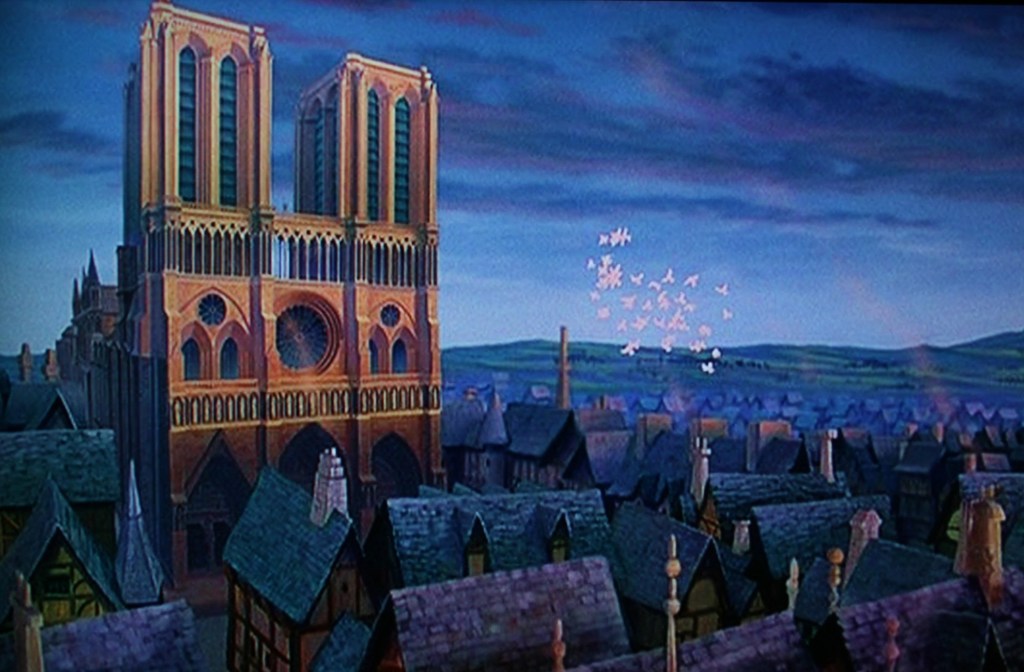
For how dark the movie is at times, it makes room for the light to shine all the brighter. The abuse of Frollo is contrasted with the numinous beauty of the purest forms of love and fidelity. The movie opens with the bell towers of Notre Dame above the clouds, a depiction of the holy and transcendent. But as the opening song continues, the viewer is taken below the clouds and into the city of Paris, where the ideal represented by the architecture of Notre Dame has to answer the idiosyncrasies of a culture filled with not just your bakers and fisherman, but gypsies, jesters, Quasimodo, and Frollo as well.

Throughout the movie, stained-glass windows, the awe-inspiring architecture, the compassion of the priest, and the eyes of the statues of saints and of Mary and baby Jesus linger behind the actions of all characters spurring them and the viewers towards deeper and more profound understandings of love.
The writers of this film, while challenging the deplorable actions of men who abuse their positions of authority, also have a deep and profound respect and adoration for the ineffable ideals represented in that cathedral. Hard not to think it’s a similar impulse that disturbed so many religious and nonreligious people alike when Notre Dame burned back in 2019.
For the self-sacrificial acts of Esmeralda, Quasimodo, Phoebus and Quasimodo’s mother are allowed to standout all the more in spite of the dark times they found themselves in.
Jesus addressed his parable of the Pharisee and the tax collector to “some who were confident of their own righteousness and looked down on everyone else.” And in it he shows that the repentant tax collector would be justified before God and not the self-righteous Pharisee.
And C.S. Lewis notes “There are two kinds of people in the end: those who say to God, “Thy will be done,” and those to whom God says, in the end, “Thy will be done.”
This is what I believe The Hunchback of Notre Dame does so well.
This distinction Lewis makes is the same as the tax collector and the Pharisee, and which is the same as man and the monster. The presence or absence of humility. And the result being a different posture before God and towards other people.
A striking difference between Quasimodo and Frollo is how they see others. Frollo, in his conversation with Phoebus refers to the gypsies as ants deserving to be squashed. Quasimodo by comparison builds an entire model of the city with handcrafted figurines representing the people he longs to walk among down below. It’s hard to find a more stark difference in view towards the people in the city.
And this is why, the Festival of Fools and the use of the jester is so fitting. When a hierarchy is as backwards as this one, with the abuses of Judge Frollo so rampant, it takes the foolish things of this world to set it back upright again. And Quasimodo, named the king of the fools, is the hero who sets the world straight again. The mysterious bell ringer becomes the soul of the city as the jester sings in the opening verse.
“Morning in Paris, the city awakes
To the bells of Notre Dame
The fisherman fishes, the bakerman bakes
To the bells of Notre Dame
To the big bells as loud as the thunder
To the little bells soft as a psalm
And some say the soul of the city’s
The toll of the bells
The bells of Notre Dame”
Much like Jesus Christ, Quasimodo represents a messianic figure that shames the strong and sets hierarchies back in order. And it’s a reminder at times that the seemingly foolish, weak, and powerless things of the world may be just the answer to tyranny.
 Upon Reflection